ADHD might be one of the most misunderstood advantages in entrepreneurship.
For many business owners, ADHD gets framed almost entirely as a liability: difficulty focusing, unfinished projects, impulsivity, procrastination, and the constant frustration of not working the way you feel like you “should.”
In a world built around structure, consistency, and linear thinking, it is easy to assume ADHD is only getting in the way. But that is not the full story.
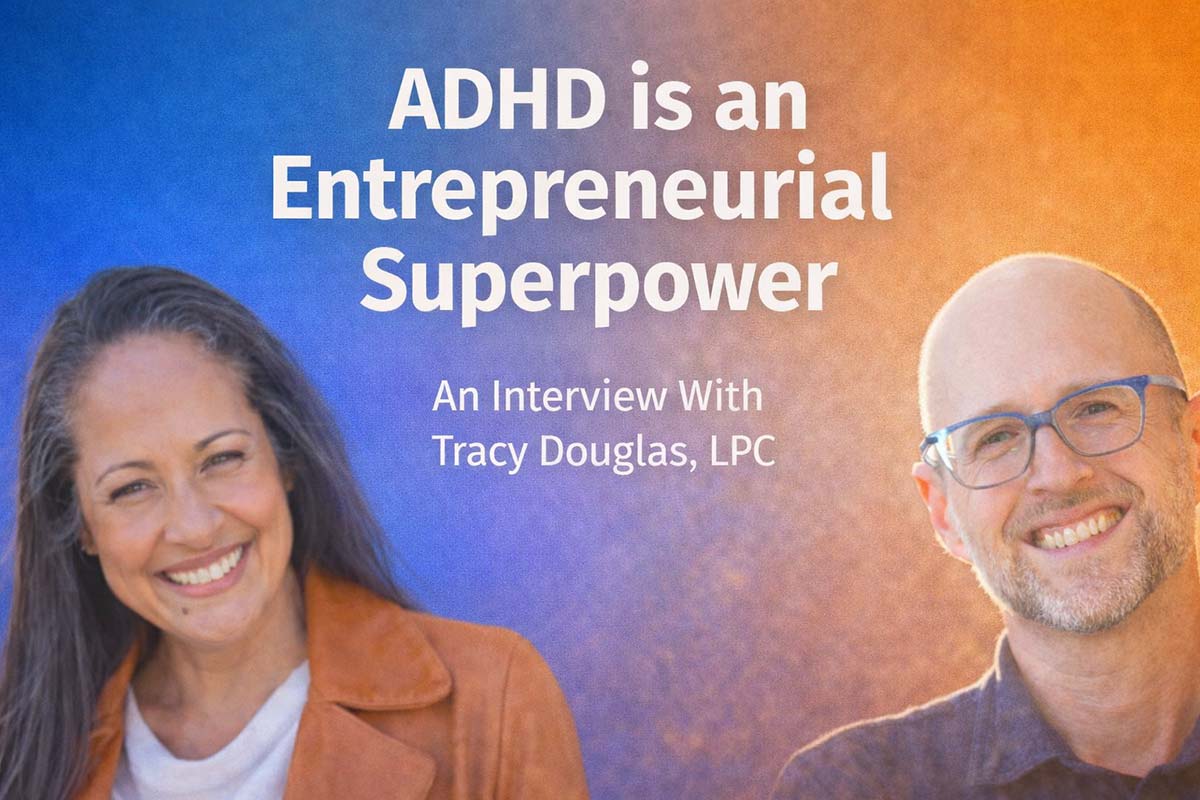
In this interview, therapist and entrepreneur Tracy Douglas, MA, LPC, shares a more honest and empowering perspective: ADHD can be both a challenge and a powerful entrepreneurial asset.
We talk about the creativity, hyperfocus, intuition, and big-picture thinking that can make ADHD-driven minds especially well-suited for building something new … along with the shame, self-doubt, and support needs that often come with it.
If you have ever felt like your brain makes business harder and more possible at the exact same time, this conversation will likely hit home.
Watch the interview
5 Key Takeaways
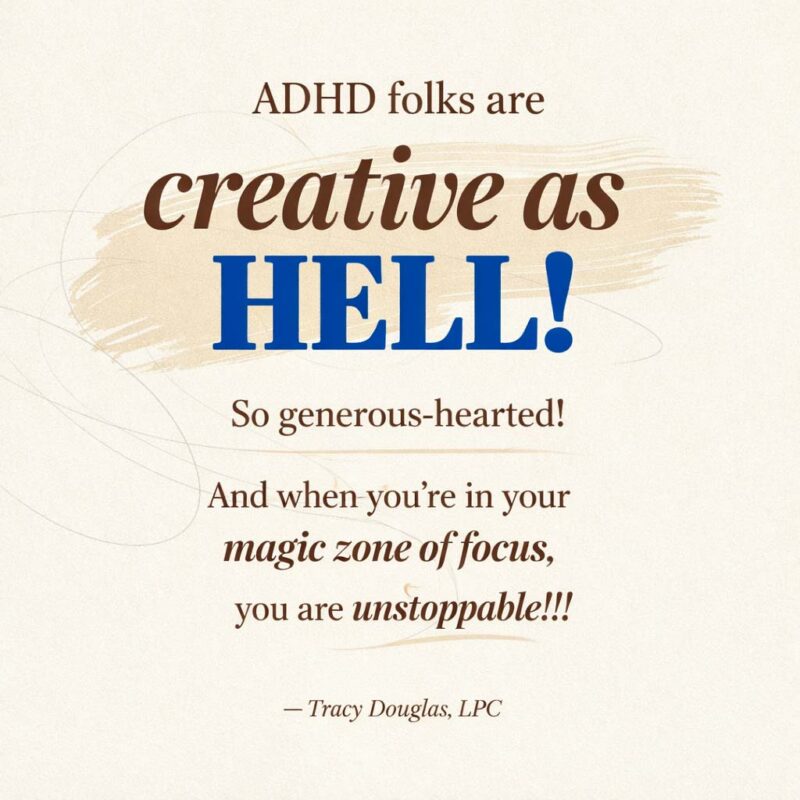
ADHD can be both a superpower and a struggle
ADHD is not simply a deficit, and it is not simply a gift. It is both. That is what makes it so difficult to talk about in simplistic terms. The same mind that struggles with follow-through, focus, emotional reactivity, or rejection sensitivity may also be highly creative, intuitive, and capable of seeing connections others miss.
That dual reality matters. When ADHD is framed only as a problem, people miss the strengths. When it is framed only as a superpower, people ignore the very real challenges. The more useful approach is holding both at once, reducing shame while learning how to recognize and leverage the strengths that come with the way the mind works.
Traditional systems often fail ADHD minds from the start
Most systems such as school, work, and broader institutions are built around a narrow definition of focus, productivity, and success. They reward linear thinking, sustained attention, and consistent execution. ADHD does not naturally align with those expectations.
Over time, that mismatch can create discouragement and self-doubt. Many people grow up internalizing the idea that something is wrong with how they think or operate. The issue is not just ADHD itself, but the repeated experience of being evaluated inside environments that were never designed for that type of mind.
Shifting out of that framework is often where change begins. When people stop measuring themselves solely against those systems, they can start identifying where their way of thinking actually works.
Entrepreneurial thinking rewards nonlinear creativity and pattern recognition
Entrepreneurship creates conditions where ADHD traits can become useful rather than purely disruptive. The ability to jump between ideas, follow curiosity, and hyperfocus on what feels important can accelerate experimentation and innovation.
What looks scattered on the surface can still produce meaningful progress. Moving between projects, exploring multiple directions, and returning with new insights can lead to stronger outcomes than a strictly linear approach. The process may be less predictable, but it often produces more original thinking.
That does not eliminate the challenges. It reframes them. In the right context, nonlinear thinking is not a flaw, it is an advantage.
Self-compassion matters as much as strategy
Many people with ADHD carry a significant amount of internalized shame. They have been told, directly or indirectly, that they are inconsistent, distracted, or not disciplined enough. That narrative becomes the bigger obstacle over time.
Self-compassion changes the equation. Instead of constantly trying to force a different way of working, the focus shifts to understanding and supporting how the mind actually operates. The question becomes less about fixing and more about working with reality.
That shift is practical, not just emotional. When people trust their process, even if it looks different, they can use their energy more effectively instead of fighting against it.
Support and community make ADHD more manageable
ADHD becomes easier to navigate in the presence of supportive environments and people. Even passive forms of support, like working alongside others in a shared space, can improve focus and follow-through.
This is partly about structure, but it is also about psychology. Being around others reduces isolation, increases accountability, and reinforces a sense of belonging. It also helps counteract the shame that often develops in more critical or rigid environments.
For entrepreneurs especially, community plays a critical role. It provides both practical support and emotional stability in a path that can otherwise feel scattered and isolating.
About the Participants
Tracy Douglas, MA, LPC
 As a licensed therapist and the owner of Your GenX Therapist, Tracy Douglas, MA, LPC helps Gen Xers understand how their minds actually work, reduce shame, and build lives that feel more aligned and sustainable.
She is certified in Emotionally Focused Therapy (EFT) for couples and individuals and trained in EMDR, Trauma-Focused CBT, Compassion-Focused Therapy, Somatic Therapy, and Narrative Therapy.
Before becoming a therapist, Tracy spent over two decades in modeling, acting, and entrepreneurship, building businesses and working in fast-paced, high-performance environments.
That lived experience shapes how she shows up with clients, helping high-achieving individuals harness their strengths, navigate complexity, and create meaningful, lasting change.
Learn more about Tracy:
Greg Goodman • Founder of Goodman Creatives
 Greg Goodman is an entrepreneur and mental health marketing strategist with over two decades of experience helping therapists grow thriving, sustainable practices.
His work sits at the intersection of authentic, human-centered marketing and an increasingly AI-driven landscape. Rather than relying on templated tactics, Greg focuses on helping therapists communicate who they actually are in a way that builds trust and connection with the right clients.
As an entrepreneur with the gift of ADHD, he approaches problems in a nonlinear way that emphasizes pattern recognition, creativity, and practical problem-solving.
As the founder of Goodman Creatives, Greg combines web design, strategy, copywriting, and visual storytelling to help therapists stand out without losing their voice. His work is grounded in a commitment to helping “the helpers” grow in a way that feels aligned, effective, and sustainable over time.
(00:01) Hello, everybody. Welcome. I’m here today with Tracy Douglas. Tracy is many things.
(00:09) In my world, Tracy is a wonderful mental health therapist in Janesville, Wisconsin. But long before our collaboration began, she was an actress starring in movies, TV shows, an entrepreneur. When I met you, Tracy, I love this. I told the story to my wife and to so many people.
(00:26) I thought it was so cool that your company, your hair forage company that you run with your family, you’re actually putting things in the swag bags at the Grammys. So I just think that’s like a whole next level of entrepreneurialism of what’s possible out there. And I just, I love that you did that with your family. Tracy is a, she ran a group practice for many years and then life said, you know what?
(00:51) you’re going to be a solo practice owner. And so she transitioned and became a solo practice owner and has had amazing success in there, going from no practice, brand new practice, to full practice in six months, winning the Best of Janesville Award for her first year of practice. And all of that said, the reason why we’re here is it’s kind of this idea that’s been percolating in my head, Tracy, since I designed your website probably like six, eight months ago, we got a live was you wrote a page about ADHD. That really stuck with me because you called it, and I quote, I love this, it’s a goddamn superpower and, or no, sorry, to use a tracism, a got damn superpower and a got damn curse.
(01:38) And that really stuck with me and has like stuck out of my brain. And I shared with you the other day that I was at a conference with a lot of other entrepreneurs and business owners and we were talking about what we’d love to shift in our in our life and our practices and the thing that kept the company in our practice in our businesses and the thing that kept coming up was this idea of ADHD holding people back. And we’re going to talk more about that because I really, I resonate so much with it.
(02:08) Like, yes, it does have certain negative sides to it, but it’s also is like in my life as an ADHD entrepreneur, I’ve seen how it’s all the amazing possibilities and the things that I get done and the way my brain interconnects in a way that, that it might not otherwise. So all that said, that was a little brief intro from the mind of an ADHD brain bouncing all over the place, totally not putting in the thing we’re going to talk about first and jumping right into who you are. So I’d love to kind of just, you know, pass it over to you to just maybe introduce yourself a little bit, a little bit of your background, fill in some of the blanks that I missed in my high-level overview.
(02:47) And thank you. Oh, thank you so much for having me, Greg. I really appreciate it. You know, talking about this topic is really near and dear to my heart because I have family members, my best friends have ADHD, the people I love most in the world have ADHD diagnoses.
(03:05) And I’ve seen the brilliance of it and I’ve seen where the struggles are of it too. So it’s a joy for me to get to be here. And, um, regarding anything you might’ve missed. You were really comprehensive.
(03:17) Thank you for that. There’s a lot of bouncing around to do because I’ve done a lot of bouncing around. And just, I guess the only thing I would add is, you know, I’ve been married for 35 years. It’ll be this summer and we have four kids.
(03:30) Our youngest just graduated from high school and she’s got ADHD too. So versed in the aspect of raising a child with it as well. And yeah, have a number of clients who, come in wanting to go, all right, how do I harness this? And it’s a joy to get to work with them because so much creativity, such giant hearts, and it can be a struggle to focus.
(03:54) It can be a struggle to know what’s going on. So I’m thrilled to be here. Thank you. Awesome.
(04:00) Yeah. And I so appreciate the perspective shift too. Like I grew up as a kid, there was no, I don’t know, maybe there was ADHD. It was just, it was ADD back then.
(04:13) And I had got the diagnosis and it kind of answered some questions. And I was like really embarrassed that I didn’t want untimed, like it was like, what is this supposed to do for me? That was kind of always my question, like, great, I got this thing. I got this piece of paper from a doctor.
(04:26) Now I can have untimed tests. But it doesn’t help the fact that the information is not there. And it’s not going to magically appear if I have an extra two hours to frustratedly stare at a blank piece of paper. So it never really, like, clicked with me for years, like, what this was.
(04:42) It was like, all right, it’s this thing. It’s a thing that someone said I am with a label. But what does it mean? Right.
(04:49) But it’s like, and then there’s this whole idea too, that it’s oftentimes just like, okay, it just means I can’t pay attention. It’s just a disease where you can’t pay attention. It was like this idea that I had in my head for such a long time before really understanding coming more to understand what it really is and all the, all the different multifaceted ways that it influences life. So I’d love to kind of just pass it over to you, like in your, in your experience, personal experience, family, clinical experience as a mental health professional, like what is ADHD?
(05:26) Right. So, you know, it’s interesting. I really, well, start at the beginning, what is ADHD? So what they’re positing now is that it can be something that is present genetically, and then circumstances can make it come more fully into play.
(05:43) Typically, it’s trauma that can kind of trigger that, but then also there are aspects of it being inherent through intergenerational an intergenerational line. And so, right, we know what it manifests in difficulty focusing, difficulty following through, impulsivity, emotional reactivity and impulsivity is something, huge rejection sensitivity, that aspect of, oh, I’m doing something wrong that hits like this. And so everybody’s got their own kind of a little bit of flavor to it and how it impacts them. But those are some of the general things.
(06:30) And I love that you started off talking about school and how it manifested during your period of schooling because, right, ADD, what did that even mean? Yeah, so you have this and nobody really did anything to work with it. Schools are not made for people with ADHD. They’re just not.
(06:55) So with you talking about the entrepreneurs that say, oh, I wish I didn’t have this. Well, of course, so much of life was geared towards a different way of learning. And so you were all like fish out of the water. You weren’t swimming in the waters that would have allowed you to have a sense of security in yourself, to know that you need support from other people to follow through on things.
(07:22) to not be shamed for the fact that, yeah, your mind can leap to all of these different places. And even to this day, I feel like while we have a better understanding of it, that still institutions, businesses, I don’t believe that they’re really creating spaces that really allow for the full brilliance of people who have ADHD. It’s fascinating. What would have to change for that, for that full brilliance to be nurtured instead of whatever’s going on now?
(08:01) Right. I think that it would have to be experiential learning. I think there would need to be smaller class sizes. I think that there would need to be the ability to allow for people with ADHD, I mean, that wonderful aspect of hyper-focusing on something, to have the resources to allow for that to happen.
(08:19) So you’d need smaller class sizes, you’d need the resources, and you would need to have an expansion of, what are you kidding me? You’re putting ADHD kids into a classroom and telling them to sit down and Yeah, now the kids get to get up and walk around, but still, and as you said, there’s accommodations that are made and that’s lovely, but we’re still teaching to rote, teaching to test still. That’s a big problem. Yeah, and I think that’s too where the entrepreneurialism comes in.
(08:53) Entrepreneurship, I never know which phrase to use, right, but being an entrepreneur to me is all about that like ability to bounce from idea to idea, to like hyper focus on something, really get into it, see if it’s viable, while for better or for worse, ignoring all exterior stimuli of all the other things. And then also, but then it’s the challenge is, okay, but I did that, but then I stopped before the finish line. And now I got really hyper-focused on this and I stopped before the finish line.
(09:24) So it’s like, this is sort of going into this, like the curse slash superpower at the same time. It’s like, I’d love to know a little bit more here, For you, you’re the coiner of that phrase, the curse and the superpower. What does that mean to you? For you, how is this both at the same time?
(09:45) Mm hmm. Right. So the aspect of not being able to finish a project and not being able to focus sometimes when you really would wish to be able to, there’s so much shame that comes around that. And so working with that shame by normalizing this, by accepting that there’s one aspect of radical acceptance that I work on a lot with people who have ADHD, and it’s got to do with an idea I read about in a book, Mark Nepo, he’s a poet and just
(10:22) a really lovely writer, seems like a lovely human. And he kind of talks about, you know, what happens in an ocean is that at different times throughout the vastness of this ocean, I know this is sound goofy, stay with me here, that krill will rise at different times in different parts and that, you know, the whales will go to where it is that it rises. And so if we look at the various things that people with ADHD have, this is what’s happening for them.
(10:51) There’s a rising and a falling of certain issues that come into play. And if we get to practice some radical acceptance around that, that’s helpful. Then also having somebody who is present with them is a really big deal. Whether that is in the moment of the work, sometimes it is, and sometimes it’s just the parallel presence of another human being can be really huge.
(11:17) somebody who’s a safe person somebody who you trust that that’s where I Think we get to be helpful regarding where ADHD is a curse the shame aspect of it on the end the focus aspect of it So I’m curious. What does that that ally? What I understand they’re there to support like what ally like what active role does that person play? so There’s an aspect of the ADHD mind where having the presence of somebody else, there’s an aspect of attuning to it, even though it might not be conscious, it’s really present.
(11:57) And so, you know, there are these wonderful workspaces now online where you just go in and you have a workspace and you don’t necessarily interact with people. but you’re all showing up for the same purpose. And having that can be really focusing. And then the allyship of people who understand the way that your mind works and like embrace the totality of it.
(12:24) Like I know my husband, he’s into a lot of stuff. And some of this stuff drives me crazy when he jumps from things to things, because he’s he is a number of steps ahead at some times. And I really value that and then sometimes I’m like dude. I’m just not moving that fast You know so Radical acceptance around that there and then also for my clients.
(12:47) Yeah, right there with them I Love the idea of the the co-workers like I’ve never has never quite clicked until here like I I love working at co-working spaces. I love getting out of this curated office of mine at home that I love and just sitting there and there’s just something intangible about the energy of being around other people who are not paying attention to each other, who are all hyper-focused on their screens and doing work, different businesses, different whatever’s there are. But there’s something about that energy of being with other people who are all really focused on what they’re doing, but there’s still this aspect of community to it.
(13:32) And as a work from home person, long before COVID, even though my wife and my kids are around all the time, there’s still like a loneliness to it that I don’t feel at the coworking space. So I just, I don’t know how related that is, but you’re talking about the online coworking space made me think about my experiences there. Yeah, and also, yeah, what’s that? That’s cool that that resonates for you.
(13:59) Yeah, and also they’re just finding a compassionate partner who is able to embrace all of you, I think is a very, sounds like a beautiful gift that you and your partner have of 35 years. Clearly there’s some good communication and some acceptance of all of our foibles in that. Absolutely. Yeah, and the whole idea, The whole idea, too, to go back to my impetus for this little chat was at this conference, what really was hitting me is, because I do feel that shame of, why can’t I just finish something?
(14:42) Why can’t I finish what I started? I’ve got a million projects at any given point, which as a business owner who serves dozens and dozens of clients, and I’ve got a team of seven people, I’m pulled in so many different directions. There are a lot of these other holes, but what I love about it is the holes that need to get filled get filled. Client work, someone needs something, that gets done.
(15:04) But it’s more in the systems and the planning and the future planning. This is how I was seeing it as a superpower. So I start to dig a hole over here, creating protocols for something. And then I get distracted because I’m like, oh, shiny object over here.
(15:20) So I start to dig another hole, which is a protocol or a way to do something. Oh, then I go and I test out a new app, because I was talking to someone about this, and it showed me an app over here. And then, so I’ve got a little bit of progress done. So then when I go back to it, I’m not starting from scratch.
(15:34) But the things I’ve learned from digging these other holes, the proverbial holes, has allowed me to build such a stronger thing as I continue to build this. So eventually, everything gets done. Maybe not. Obviously, if I just dig one hole and do it and finish it, it would be done immediately.
(15:52) So the bigger picture takes a little bit longer, but meanwhile, there’s circuits and synapses firing and connections being made. It’s like, oh my God, this completely unrelated thing is completely related to over here, and it’s going to make this that much stronger. And yet I rushed to finish this, or whatever word you want to use to finish this. I never would have had that breakthrough, and I wouldn’t have wanted to go back and redo this, because I would have been on to the next thing.
(16:16) So that was like this, that was sort of where my mind went to like why I would counterpoint to like, yes, sometimes it’s frustrating and there’s negative self-talk that goes on. Like at the same time, it’s also like this amazing gift of being able to have hold this many thoughts and things at one time. And I say that, you know, yes, as therapist and entrepreneur, I’m curious your take on that. I think that is absolutely brilliant.
(16:44) And I just love the grace that you showed yourself in that saying, yeah, I had the, you know, shame around starting all of these things and jumping from shiny object to shiny object, and then coming to a realization I got my stuff done. And if I hadn’t pursued these other avenues, I wouldn’t have gotten it done in a way that I’m really happy with. And so with that shame that can come up, the self-compassion is so huge, the recognition of how it does really serve you. And that requires a kind of a faith in yourself.
(17:28) And right, so many times, like we were just talking about in school, our faith in ourselves can get broken. Oh, the way you work is not the way that this is, and this is how you get grades, and this is how you succeed. Right. So having compassion around knowing that this is the way that you work and it’s okay.
(17:47) It’s very different from this cookie cutter. These are the steps that you achieve to get to such and such a place. That’s why I think ADHD entrepreneurs, man, that’s fun. It’s just fun.
(18:02) It is. It’s a rollercoaster for sure. Yeah, it is. It is.
(18:08) And there’s so much creativity, and that’s part of it. It gets to be messy. It gets to be. I love encouraging more messy.
(18:17) We don’t have enough messy, so that we embrace that we don’t know at a given time, that we embrace that, oh, look, this just called to me here, and I’m going to explore this. And then you’ve built faith in yourself that it’s all going to lead somewhere. And that’s part of what I hope to do as a therapist, too, is to help people know that they get to trust in themselves. Many times, I will hear about this piece of, I procrastinate, I procrastinate, I procrastinate.
(18:41) I’m like, yeah, you do. You do. And you get it done, and this is how you work. Do we get to figure out how you get to be gentler with yourself as you do this?
(18:52) Yeah, we get to do that. I don’t know that you’re ever going to finish a task a month ahead of time. You don’t work that way. You don’t have to work that way.
(19:00) So that radical self-acceptance, the radical acceptance and the self-compassion are huge. Acknowledging all that, and I genuinely love all that, so then how do you take that into a society and a system that we live in, going back to what we were talking about 10 minutes ago, that is not created to nurture that, to be compassionate to that, where that is not what is required. And I’m mixing things with entrepreneurial, folk and more 9 to 5 job.
(19:39) But at the same time, even as an entrepreneur, there’s still this world that I live in that is definitely not inducively created to meet my needs. Right, right. But you’re creating it now. You just told me you went to a conference of entrepreneurs and ADHD came up a ton.
(20:01) You’re finding your community. And man, I am a huge fan of entrepreneurship. When I’m working with any client, whether they have ADHD or not, I am looking for strengths. I’m looking for passions.
(20:15) I’m looking for possibilities because I really believe entrepreneurship is our future. So for us to be able to have, to be empowered, to know what our strengths are, know what our leading edges of growth are, and to find the community to support us. That’s how we do it. We forge it ourselves.
(20:33) Right on. Forge your way. I love it. Seriously, I love it.
(20:39) I want to use that forging as a segue to creating it yourself. One of the last topics I wondered, and I could easily talk more about this if you have more ideas that pop into your head, or I’d love to give you any any suggestions, I don’t want to say advice you have to folks on that. And we will end with that. But like, also, the one other thing I want to talk about was this concept of personal brand.
(21:05) And it’s kind of like a little bit of a segue. But like, while I have you here, it’s not directly related to the ADHD topic. But just this idea of like, forging your own way through personal branding, through like, admitting whether you’re a public-facing figure, you have a very public-facing side to you, so maybe you’re more comfortable in this world of putting yourself out there than a lot of these folks at the conference are who are hiding behind a computer or hiding behind the business face.
(21:37) And there’s just this whole concept of founder-led marketing and personal branding, and especially, you know, as a solo practitioner, a mental health professional, or as an agency owner, or anyone in the world of startups, or being a business owner, like, it is that person, the you, in the business. And it’s, you know, whether you call it a personal brand, or founder-led marketing, or whatever you want to call it, it’s about creating that connection with a person through you authentically being you. And I just think that you, Tracy, are a wonderful example of that.
(22:13) On your website, the very first thing you do is you drop the F-bomb on your homepage. And I get so much feedback about that simple thing. You’re like, yeah, I was looking through your website, and there’s that one person. And some people are like, I could never do that.
(22:27) That’s not me. And some people are like, oh, I could totally see myself. That’s the type of putting myself out there that I want. But regardless of someone’s stance on it, it is uniquely and beautifully and authentically you.
(22:40) And I think that that’s this critical part about a personal brand. So to tie it back to the entrepreneurs and to the ADHD, it’s like, so how do you bravely put yourself forward, be your authentic self, being kind to yourself, embracing the quirks, the things that make you you? And what tips would you have for someone who’s trying to be more, putting themselves out there, and we’re talking through the lens of an entrepreneur, but any human being, just embracing that true themness. Okay, big question, Greg.
(23:19) I kind of bounced all over the place with that, but I wanted to tie it back, because I wanted to just acknowledge your strong personal brand, but it’s also, I think, related to the conversation. Agreed, completely. And thank you very much for your kind words. I love my website so much, and so do all the people who find me.
(23:38) It’s amazing how it is that, right, me getting to speak in my voice finds the people who resonate with what I say, and already there’s built-in trust, built-in faith that this is going to be a fit. So thank you very much for that. Gosh, you are such a huge part of making that happen. So I know I’ll get to thank you for that as well.
(24:02) And so you had asked me about, how do you get to a place of being able to embrace your authenticity, and put yourself out there? Because so much of what is happening now, as you said, founder led marketing personal brand. So that there’s personal work to be done, right? Whether it’s done through therapy, I don’t care.
(24:31) There are so many paths to healing. What you’re talking about, that lack of faith in yourself, to do that through coaching, through mentoring, through a supportive group, all of those are good. Self-help books are fine. There’s so much online that’s available now to explore where your leading edges of a growth are.
(24:55) That’s the first place you got to start. You got to clear away any misconceptions that you might have about yourself, your worthiness, that you have something that is valuable and necessary to say. That’s something that’s personal that I think that is huge for people to be able to get to do. Next, build a support network.
(25:18) That is so important. I did not quite realize until I got into business about, that’s vital. You know, people who isolate themselves, that one beautiful saying, if you wanna go fast, go alone. If you wanna go farther, travel with somebody.
(25:36) That’s just the truth. So find support. The next thing I think that is so huge, holy smokes, how amazing is it for us to live in the technological age that we live in? Our voice can be heard in so many different ways.
(25:52) We can use text, we can use animation, we can use somebody else as a representative for us. Oh, one of those, that’s so weird. Those little things come up for me randomly. I’ve never been able to harness those.
(26:07) So lean into, yeah, see, when you’re talking. I thought it was supposed to give me confetti. Anyway, keep going. Oh, there we go.
(26:15) Okay. Right on. I think it’s my enthusiasm, Greg. There you go.
(26:23) There you go. The universe is applauding you with confetti. I’ll take it. Again, support, right?
(26:32) In all the various forms. And then to go, Oh man, look at all the ways that other people are expressing themselves. What resonates for me? What, you know, do I want to do the Instagram?
(26:44) Do I want to do website? Do I want to do a blog? Do I want to do a podcast? Do I want to do all of these things?
(26:49) We live in an unprecedented era of access. And I believe that the more authentically, whether that means it’s us that is forward facing or something else, we have choices. And so educate yourself really well on that. And then just experiment.
(27:08) Ralph Waldo Emerson says, what is it? Don’t something along the lines of don’t don’t be too serious. Life is all an experiment. And I love that.
(27:19) Yeah. Me too. What a gift, right? The life experiment where we truly do get to mix whatever little potions, little things into the beaker and create whatever we want at any given time.
(27:34) And I think that’s one of the most incredible things that at any given moment, we get to consciously choose what we do next. Whether it’s easy or not, debatable. But it does get to be a choice, right? So I love that.
(27:49) Yeah, I really appreciate your input, your energy, everything you do over there. Is there anything else that, you know, any other sort of parting Tracy words of wisdom to circle it back to like, you know, just the entrepreneurs, the ADHD, anything we’ve talked about, or we can just say, that was fun, bye. Well, you know, so I’m a giant reader, and this may be helpful, and it might not be helpful. I just read the book 4,000 Weeks, I think it came out within the past year, and it’s something that really stuck with me.
(28:26) And it’s a little bit, I don’t know, Morbid might be the word, but people will get to decide, you know, 500 years from now, nobody’s going to remember my name. Nobody’s going to remember who I am. And so while I’m here, I’m going to bring the fullest of myself to it, you know, and I’m going to play and I’m just going to see because in the grand scheme of things, my task is to be fully me. and to love myself through it.
(28:55) And I believe that’s true of everybody else. And to Ram Dass, we’re all just walking each other home. So let’s walk each other home with grace and support. Can’t ask for a better Half to our chat than that.
(29:12) I got chills. I love it. Well, thank you, Tracy, very much for your time, for your everything. If you want to find Tracy online, it’s yourgenxtherapist.com, or probably many other websites that I don’t know about are out there as well.
(29:30) But Tracy Douglas, super duper awesome human being, grateful for you and all that you’re doing. And if you need a therapist in Janesville, Wisconsin, That person right there is a little shout out. Anyway, thank you, Tracy. I appreciate you.
(29:43) Thank you so much, Greg. Likewise. All right. Have a great day, everyone.
(29:48) Thanks for watching.
 Greg Goodman: