For decades, therapists have heard the same advice: SEO is how you get found without paying for ads. Rank on Google, and new clients find you.
Then AI came along. People started asking ChatGPT, Perplexity and Google’s AI tools to find them a therapist … and a lot of SEO agencies said the same thing: good SEO is good GEO, so there’s no need to change the plan.
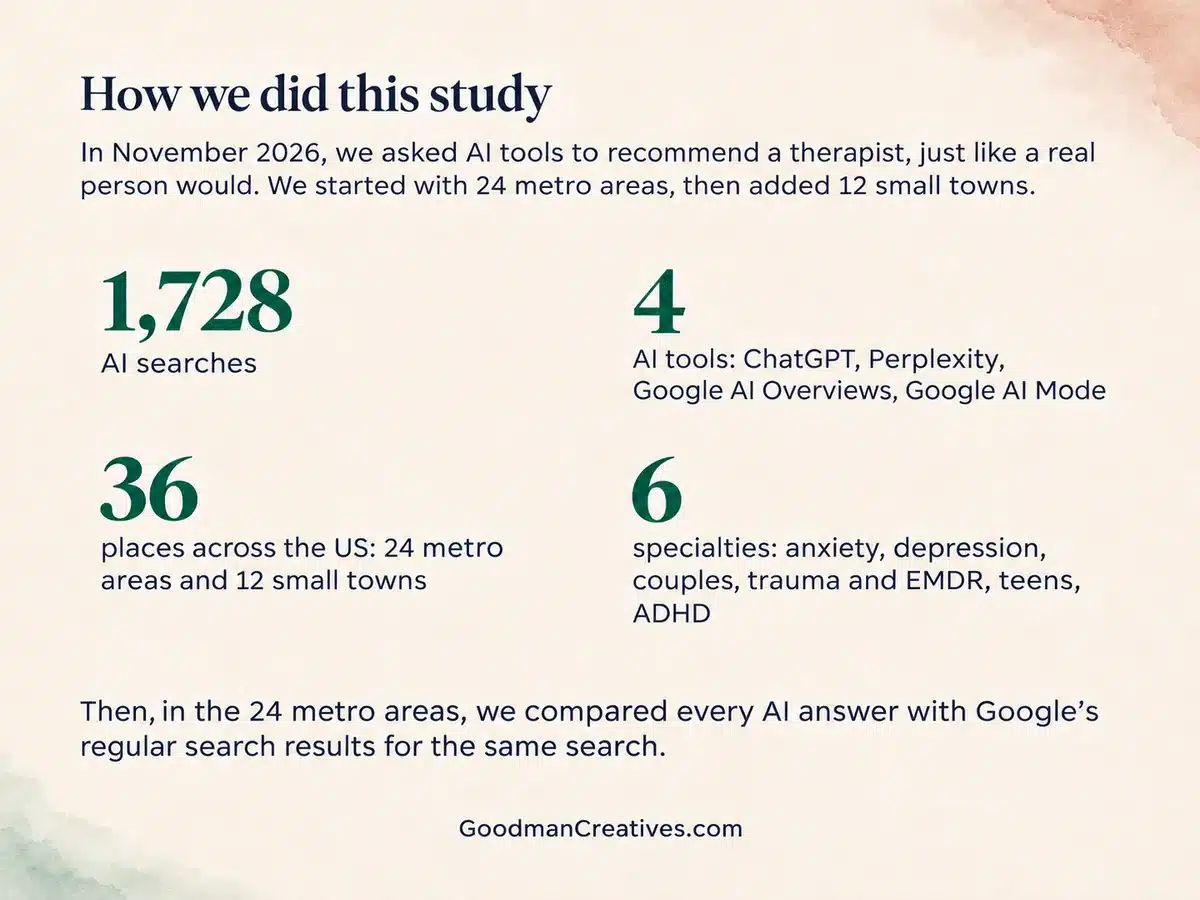
We wanted to know if that’s true, so our team ran 1,728 therapist searches on four AI tools in 36 US cities and towns, then compared the answers with Google’s regular search results. Here’s what we found.
The facts at a glance
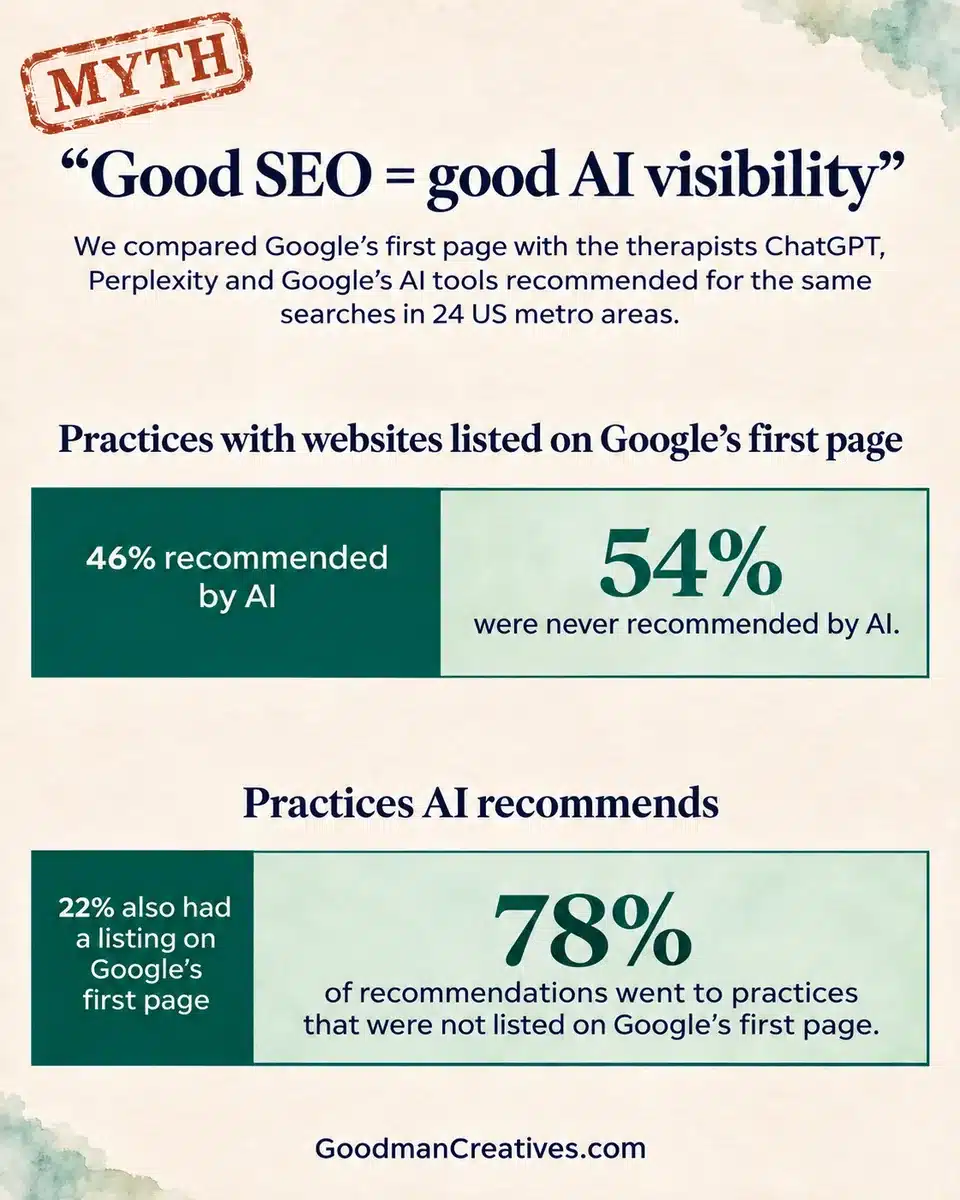
- Ranking on Google doesn’t guarantee an AI recommendation. In the 24 metro areas we compared, more than half of the therapy practices on Google’s first page (54 out of every 100) were never recommended by any of the four AI tools.
- A page-one ranking isn’t required, either. Nearly 4 out of 5 practices the AI tools did recommend weren’t on Google’s first page.
- AI recommends real local therapists. On every tool, at least 94 out of 100 answers named an independent practice, and in about 9 out of 10 answers, the first name was an independent practice.
- AI often sends the click to Psychology Today. Perplexity linked about 9 out of 10 therapists it recommended to a directory or therapy platform. And about 8 out of 10 therapists linked only to Psychology Today had their own website listed right on that profile.
- The tool someone uses changes where they land. Google’s AI Mode linked about 8 out of 10 recommended therapists to their own website. Perplexity linked about 1 out of 10.
- The practices AI recommended looked like established local businesses. They had more Google reviews and a Google Business Profile under the practice name, and they named their city and specialty on their homepage.
Quick note: what this study can and can’t tell you
This is one snapshot, taken November 16 and 17, 2026. AI answers change constantly, so treat these numbers as a picture of that moment.
The study shows patterns across thousands of AI answers, and no single change on this list comes with a promise.
We’re a marketing agency, so we’ve kept our methods open. The full methodology and the de-identified dataset are at the end of this post, for anyone who wants to check our work.
Words we use in this post
- Google’s first page: the regular website results you see when you search on Google, not counting ads or the map.
- AI tools: ChatGPT, Perplexity, and Google’s two AI features. AI Overviews is the AI summary at the top of some Google searches, and AI Mode is Google’s chat-style search.
- An answer: the reply an AI tool gave to one question. One answer often names several therapists.
- Recommended by AI: the AI tool named the practice in its answer.
- Linked to their own website: the link in the answer went straight to the therapist’s or practice’s website.
- Linked to a directory: the link went to a profile on a site like Psychology Today, or to a therapy platform.
GEO, in plain English
GEO stands for generative engine optimization. It’s the work of getting AI tools (ChatGPT, Perplexity, Google AI Overviews and Google AI Mode) to mention and recommend you when someone asks them a question.
The term took off after a 2023 research paper out of Princeton and other universities that studied how websites show up in AI-generated answers. Since then, “GEO” has turned into a marketing buzzword, and a LOT of digital marketing agencies have folded it into their
packages.
For a therapist, the question is simple. When someone types “find me an anxiety therapist in Denver” into ChatGPT, does your name come up? And if it does, does the link go to your website?
That question matters more every year. Our study of 11 years of therapy search data found people are searching for therapy as much as ever, but more of them now turn to AI first.
SEO vs GEO: how they’re different
Traditional SEO (search engine optimization) and GEO overlap, but they show up on different screens.
| Traditional SEO | GEO | |
|---|---|---|
| The goal | Rank high in Google’s search results | Get named in AI-generated answers |
| Where it shows up | Google and other search engines | ChatGPT, Perplexity, Google AI Overviews and Google AI Mode |
| What success looks like | A high ranking, then a click | A mention, a recommendation and a link |
| What it’s built on | Keywords, helpful content, backlinks and technical SEO | Still being studied (this study is part of that) |
You may also hear AEO, short for answer engine optimization. For a therapist, it means about the same thing.
The big difference is the answer itself. Large language models (LLMs) like ChatGPT synthesize direct answers from many sources, so a person may see three or four names and never scroll a list of search results. For your practice, AI visibility comes down to one question: are you part of that answer?
How we ran the study
We asked the same therapist questions the way real people ask them. In ChatGPT and Perplexity, that meant full sentences like “Find me an anxiety therapist in Denver.” In Google, it meant searches like “anxiety therapist Denver.”
- 24 metro areas, 12 large and 12 mid-size, spread across the Northeast, South, Midwest and West
- 12 small towns, from Keene, New Hampshire to Missoula, Montana, added after the main study
- Six specialties: anxiety, depression, couples, trauma and EMDR, teens and ADHD
- Four AI tools: ChatGPT, Perplexity, Google AI Overviews and Google AI Mode
- Google’s regular results for the same searches, so we could compare
A Google ranking doesn’t guarantee an AI recommendation
Here’s the number that should make every therapist pause.
In the 24 metro areas, more than half of the therapy practices on Google’s first page (54 out of every 100) were never recommended by any of the four AI tools for that city’s searches.
That includes practices at the very top: of the 74 practices that ranked #1 on Google for at least one search, 28 never came up in a single AI answer for their city.
One example stuck with us. A trauma practice in a big East Coast city held the #1 spot on Google for an EMDR search. We ran 12 therapist searches for that city on all four AI tools, and none of them mentioned that practice even once.
It works the other way, too. Nearly 4 out of 5 practices the AI tools did recommend weren’t on Google’s first page for that city’s searches.
What this means for you: a strong Google ranking is worth having, but it won’t automatically put your name in AI answers.
Rankings still help (a little)
To be fair to traditional SEO: among the practice sites that were on page one, the higher ones did better. Out of every 10 practices in the top three spots on Google, about 6 were recommended by an AI tool. Lower on the first page, it was about 4 out of 10.
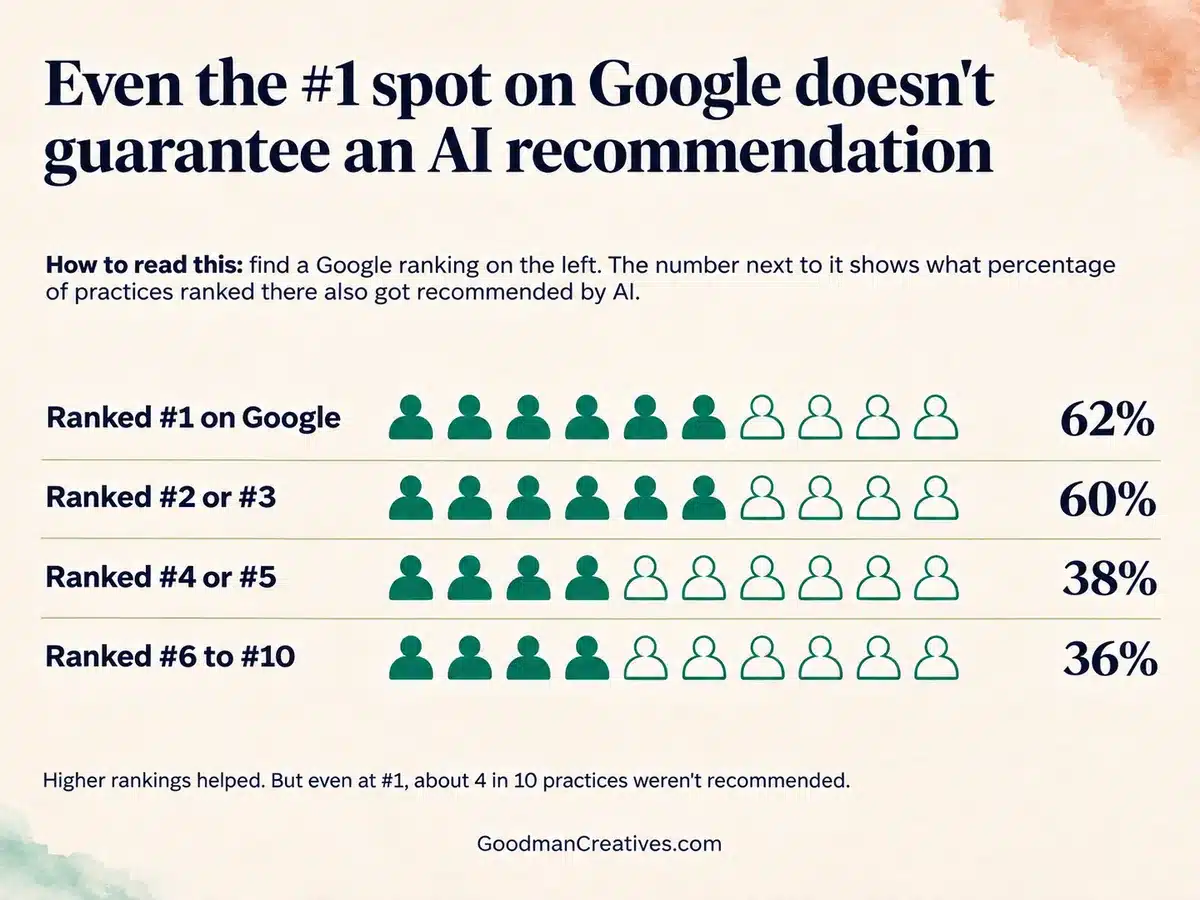
Google itself says a business’s position in web results also feeds its local ranking. So SEO best practices still matter.
Translation: A good Google ranking helps, and plenty of practices get recommended without one.
So when AI skips past the Google rankings, where does it send people? Often, to a directory.
AI names real therapists, then often sends the click to Psychology Today
First, the good news. AI tools recommend real, local, independent therapists.
At least 94% of answers on every tool named an independent practice. On ChatGPT, it was 99.7%. Large chains and online platforms showed up, but in about 9 of 10 answers, the first name on the list was an independent practice.
The catch is where the link goes.
Psychology Today is everywhere
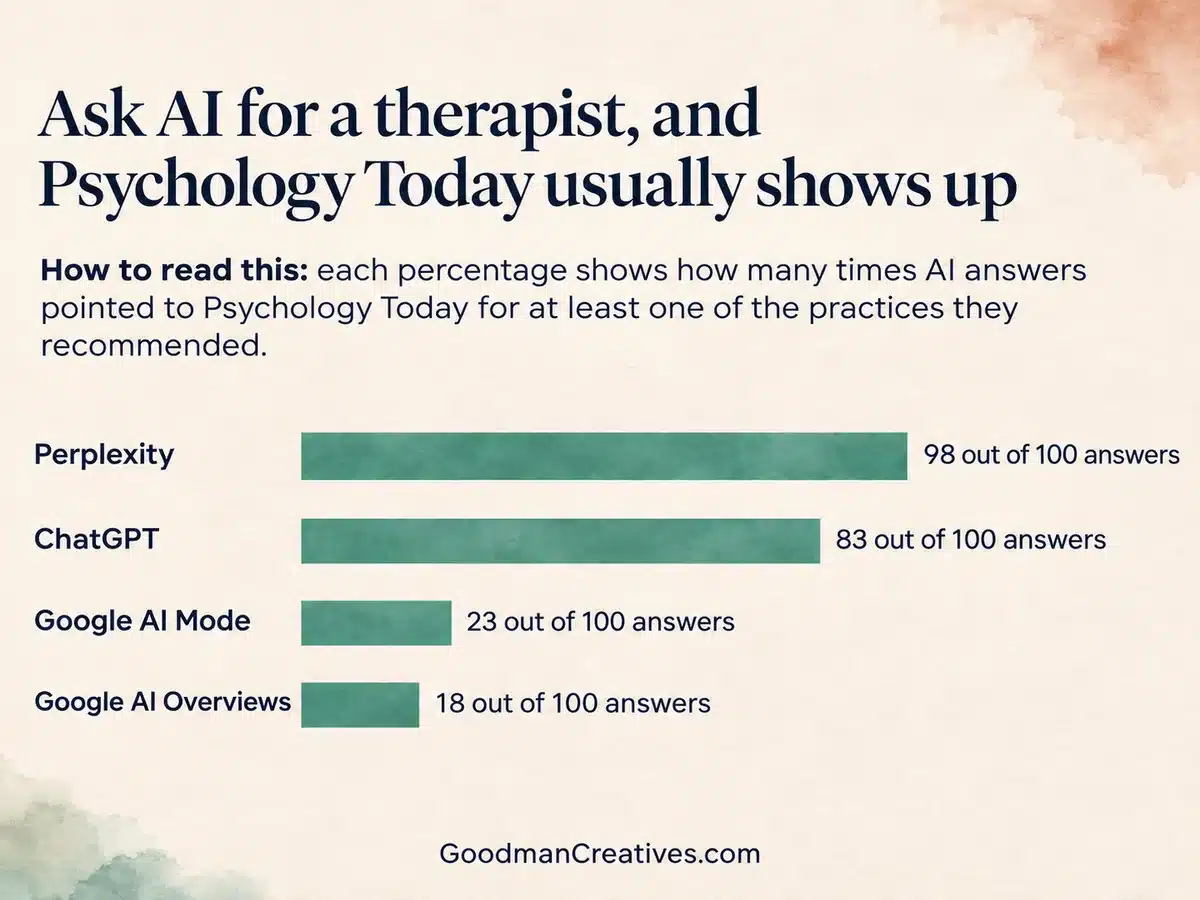
Out of every 100 answers Perplexity gave, 98 mentioned or linked Psychology Today at least once. For ChatGPT, it was 83 out of 100. Across all four tools, it was about 6 out of 10 answers.
On Perplexity, about 9 out of 10 independent therapists it recommended (86%) were linked to a directory or therapy platform. Only about 1 in 10 (13%) got a link to their own website. ChatGPT sent roughly 3 out of 10 (27% to 30%) to directories or platforms, and about 6 out of 10 (62%) to the therapist’s own site.
Most of those therapists had websites
You might assume AI links a directory profile because the therapist has no website. Mostly, that’s not what we found.
We checked the Psychology Today profiles of a random sample of 130 therapists whose only link in an AI answer was that profile. About 8 out of 10 (77%) had their own website listed right on that profile. The AI tool linked the directory anyway.
Ouch.
For those therapists, the website exists. The directory just gets the visit first.
What this means for you: if you’re on Psychology Today, AI may send people to that profile even when you have a website. Make sure the profile points clearly to your site.
Outside the big cities, it gets more lopsided
In the largest metro areas, Perplexity linked about 3 out of 4 independent therapists (77%) to a directory or platform. In mid-size cities and small towns, it was about 19 out of 20 (95%).
ChatGPT linked therapists’ own websites less often in smaller places too: 69 out of 100 in big metros, 61 in mid-size cities and 54 in small towns.
So the front door changes depending on where you practice. It also changes depending on which tool someone opens.
Which AI tool someone uses changes where they land
The four AI tools behaved like four different referral sources.
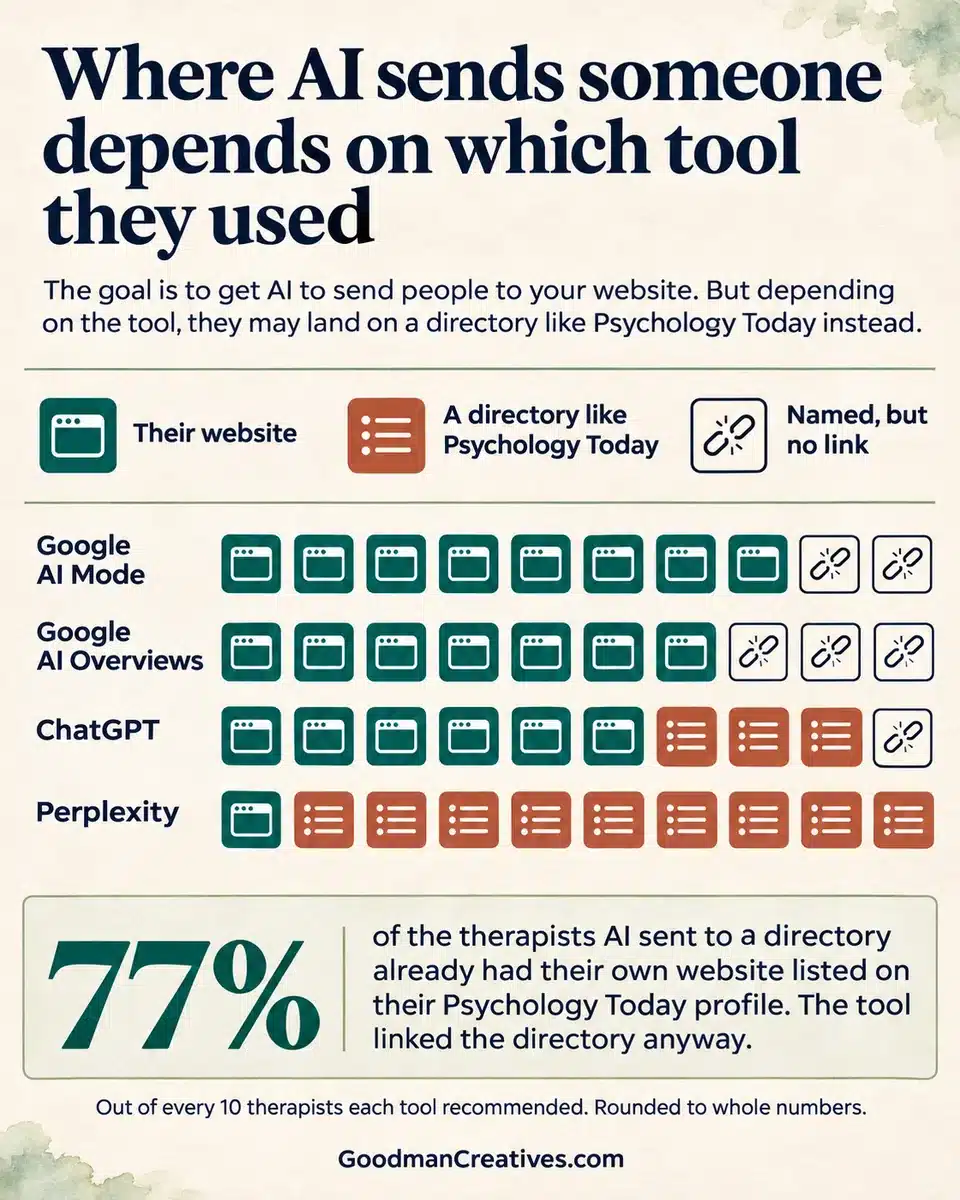
| AI tool | Recommended therapists linked to their own website | Linked through a directory or platform |
|---|---|---|
| Google AI Mode | 76% | about 4% |
| ChatGPT | 62% | about 27% to 30% |
| Perplexity | 13% | 86% |
Share of independent therapists each tool recommended, by where the link went. The rest had no link. Google AI Overviews only appeared on 126 of 288 searches, and its practice links ran through Google’s own buttons.
Google AI Mode leaned hardest on Google’s own business listings, which link straight to a practice’s website. Perplexity leaned on directories.
What this means for you: there’s no single “AI” to show up in. Each tool leans on different sources, so a practice needs to look solid in all of them.
ChatGPT changes its mind
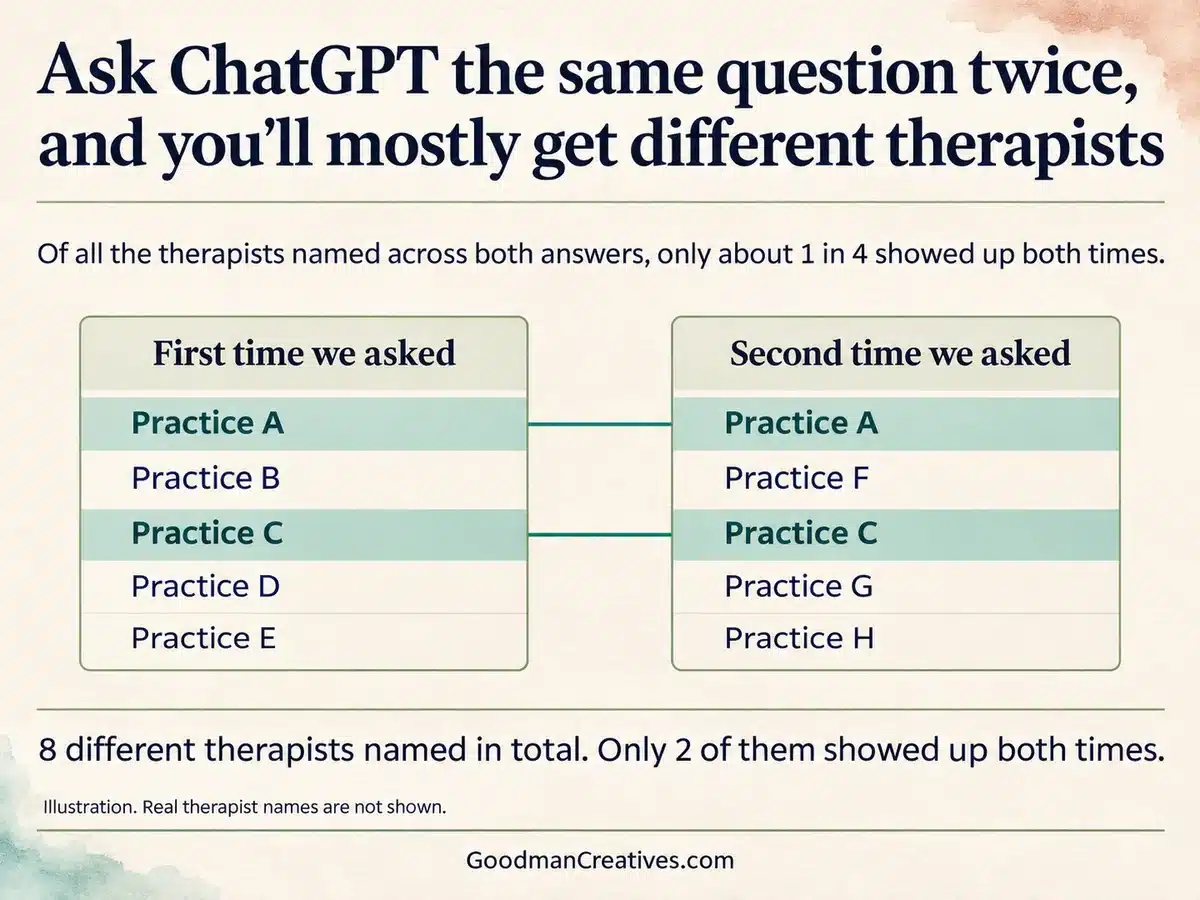
We asked ChatGPT some of the same questions twice. Of all the therapists named across both answers, only about 1 in 4 showed up both times. Perplexity was more consistent: about 2 out of 3 showed up both times.
What our clients are seeing
This matches what we’ve seen at Goodman Creatives. Some of our clients were getting found through AI chatbots before we did anything AI-specific. It came from solid, old-school SEO.
Debbie Cherry, LMFT, is one of them. Her site had 24 visits from ChatGPT and other AI assistants in August 2026. In her words:
“I now have private pay clients who are an ideal fit for my couples therapy practice consistently finding me through ChatGPT and other LLM platforms.”
So yes, good SEO can lead to good GEO. But our clients’ experience with the quality of those referrals is mixed.
You’d think a referral from a chatbot that knows someone well would be almost as good as a referral from a friend. Some clients tell us it is. Others tell us the people who find them through ChatGPT often aren’t a great fit.
Which raises the real question: what did the practices AI recommended have in common?
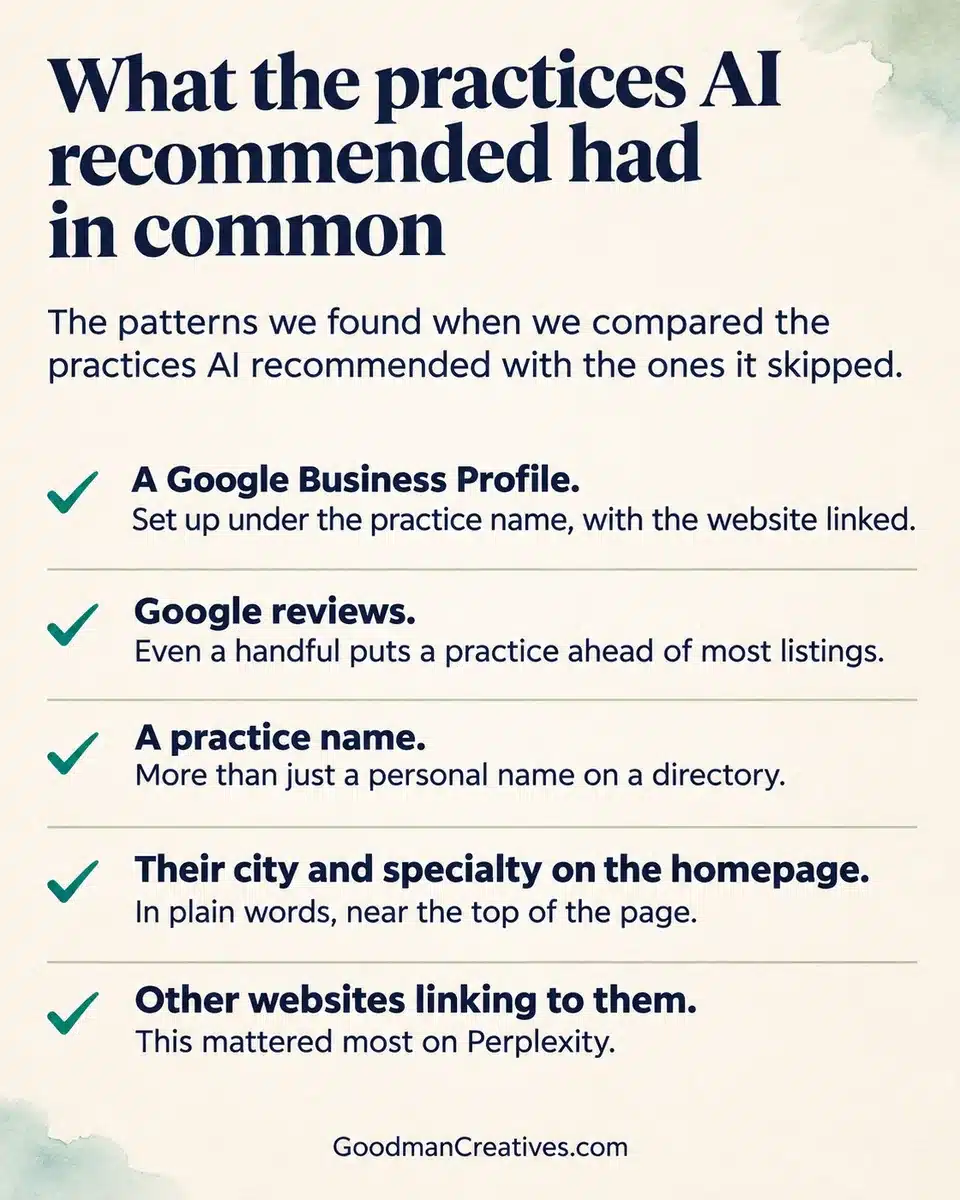
Signs the practices AI recommended had in common
We compared the practices AI recommended with the ones it skipped. A few patterns stood out, and none of them was “great SEO.”
These are patterns, not proof. A busy, well-known practice tends to have all of these things at once. Still, they line up with how Google says it judges local businesses.
A Google Business Profile under the practice name
A Google Business Profile is the free listing that shows your practice on Google Maps and in Google’s map results. Therapists AI linked to their own website were about 6 times as likely to have one we could find under their name.
The gap was biggest for practices with a business name. Of those ChatGPT linked to their own site, 76 out of 100 had a Google Business Profile we could find. Of those it sent to Psychology Today, only 7 out of 100 did.
A practice name people can recognize
The therapists AI sent to Psychology Today were mostly listed under their own names (86% on ChatGPT). On ChatGPT, the therapists it linked to their own websites were split about evenly between personal names and practice names.
Directories are built around individual clinicians. A practice that exists as a recognizable local business gives AI something else to point to.
More Google reviews
Out of every 100 practices with no Google reviews, about 4 were recommended by an AI tool. With 25 or more reviews, it was about 22 out of 100.
That’s roughly 3 to 5 times as often, depending on the cities you count. On Google AI Mode, the gap was even bigger: about 10 to 15 times.
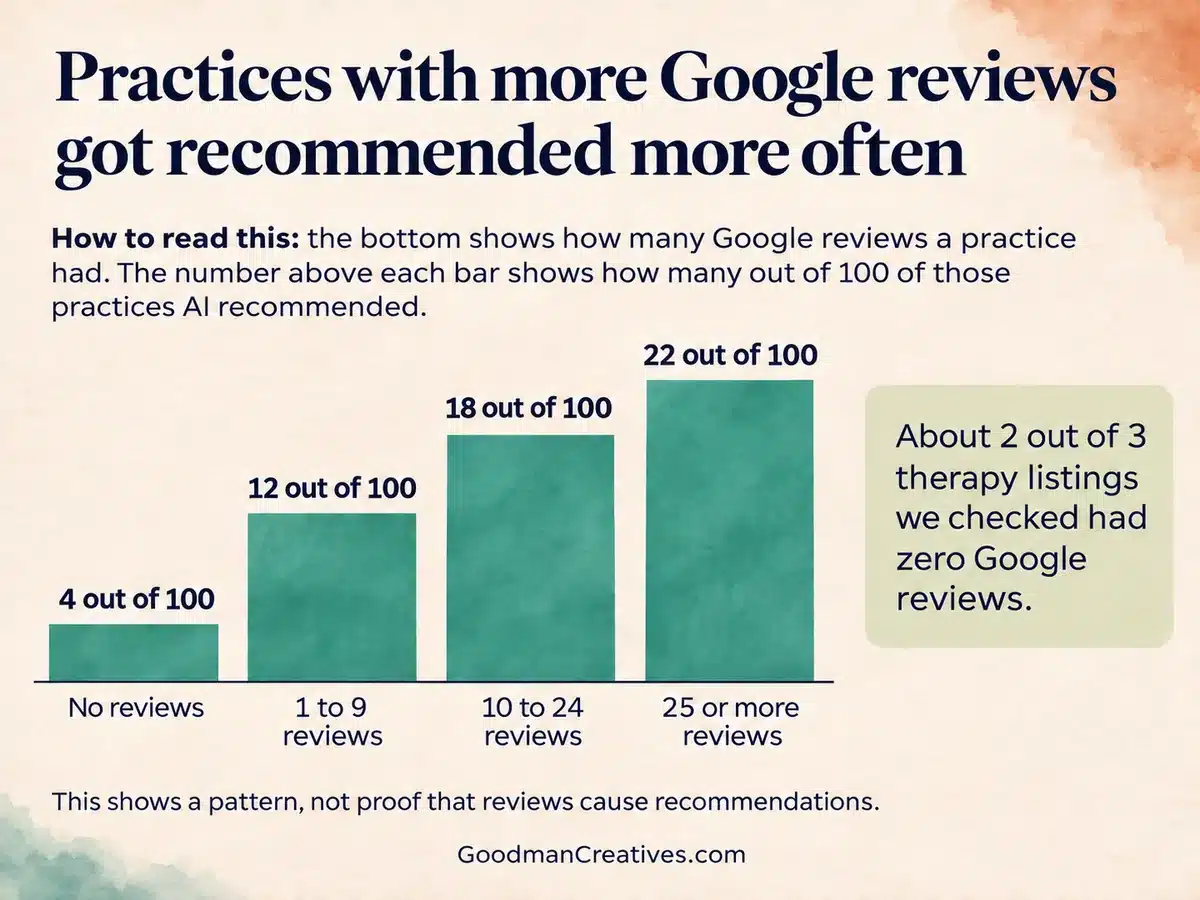
That may sound like a lot to ask, but the bar is low. About 2 out of 3 (65%) of the roughly 22,000 therapy listings we pulled had zero Google reviews.
Google says review count and review score factor into local ranking, and Google’s AI Mode draws on those same listings. (Reviews need care in a therapy practice. This isn’t legal advice, but follow your licensing board’s rules and never reply in a way that confirms someone is a client.)
A homepage that names the city and the specialty
Among practice websites on Google’s first page, the ones AI recommended were more likely to name their city (79 out of 100, compared with 68) and their specialty (74 out of 100, compared with 64) in the homepage title, main heading or description. Those are the words in the browser tab, the big headline at the top of the page and the short description Google shows under your link.
Authority, mainly on Perplexity
Backlinks (other websites linking to yours) and domain authority (a score for how much search engines trust a website) mattered most on Perplexity, which runs on live web search. Here’s how the two groups compared on Perplexity:
| On Perplexity | Linked to their own website | Sent to Psychology Today |
|---|---|---|
| Typical domain rank | 179 | 54 |
| Typical number of other websites linking to them | 186 | 68 |
| On Google’s first page for that city’s searches | 78% | 12% |
| Typical Google review count | 11 | 3 |
| 10 or more Google reviews | 51% | 19% |
Practices with a website we could identify: 70 linked to their own site, 57 sent to Psychology Today (the page-one row covers the 24 metro areas only). Domain rank from DataForSEO, on a 0 to 1,000 scale.
Want a website that both Google and AI trust?
Our goal is a website the robots (Google and AI) trust enough to send humans to, that inspires those humans to book a consult. The Prosperous Practice Foundation Program builds that foundation for solo practice owners, from clarity on your dream clients to a custom website.
Book a Consult
So is good SEO good GEO?
Sometimes. Our own clients prove that: some were getting AI referrals from SEO alone.
But the study shows it’s far from automatic. More than half of page-one practices got skipped, and nearly 4 in 5 AI picks weren’t on page one at all.
And even when AI did find a therapist, it often handed the click to a directory.
Remember that #1-ranked trauma practice? Strong SEO got it to the top of Google. It didn’t get it into a single AI answer.
SEO is still part of the job. It’s just no longer the whole job.
AI tools seem to look for what anyone asking a friend for a referral would want to know:
- Is this a real local practice?
- Do people vouch for it?
- Does it clearly help with what I’m struggling with, where I live?
The practices that answered those questions clearly got picked more often.
How to get recommended by AI: what to do next
Here’s where we’d start, in order.
- Claim and complete your Google Business Profile. Use your practice name, your city and your specialties, and link it to your website.
- Build Google reviews, carefully. Even a handful puts you ahead of most listings. Follow your licensing board’s rules, and never confirm in a reply that someone is a client.
- Name your city and specialty on your homepage. Put them in the page title, the main heading and the first paragraph, in plain words.
- Point every directory profile to your website. Keep your name, address, phone number and specialties the same everywhere.
- Give your practice a name AI can recognize. If you go by your personal name, make sure it reads clearly as a local practice everywhere it appears.
- Keep doing solid SEO. Rankings still help, especially at the top of page one, and authority matters most on Perplexity.
- Test your AI visibility. Ask ChatGPT, Perplexity and Google AI Mode for a therapist like you, in your city, a few times each. Notice who comes up and where the links go.
Running a group practice?
Showing up in AI for every clinician and specialty takes a whole marketing team. The Growth Accelerator Program gives group practices that team: ongoing, done-for-you marketing from people who only work in mental health.
Book a Consult
Frequently asked questions
Can GEO replace SEO?
No. Generative engine optimization builds on search engine optimization. Rankings still helped in our study, and Google says your position in web results feeds your local ranking. GEO adds to SEO: the extra signals AI tools seem to look for, like reviews, a clear Google Business Profile and a homepage that says who you help and where.
Do I need GEO if I already do SEO?
Probably. More than half of the practices on Google’s first page weren’t recommended by any AI tool for that city’s searches. Good SEO helps, but it didn’t lock in a spot.
Is SEO still relevant in 2026?
Yes. Among practice websites on Google’s first page, the higher-ranked ones were more likely to be recommended by AI, and some of our clients get AI referrals from SEO alone.
Do backlinks still matter in AI search?
They seemed to matter most on Perplexity, which searches the web live. On the other tools, reviews and a clear Google Business Profile lined up more strongly with being recommended.
Can a small practice compete in AI search?
Yes. Nearly 4 in 5 practices AI recommended weren’t on Google’s first page, and in about 9 of 10 answers, the first name was an independent practice.
Does ChatGPT always recommend the same therapists?
No. When we asked ChatGPT the same question twice, only about 1 in 4 of all the therapists named showed up both times.
Why does AI link to my Psychology Today profile and skip my website?
Our data can’t say for sure. Directories are everywhere in AI answers, and the therapists AI linked to their own sites tended to have a Google Business Profile, more reviews and a practice name. Pointing your directory profiles to your website and keeping your details consistent is a good start.
Methodology and full data
| What we did | |
|---|---|
| When | November 16 and 17, 2026 |
| Where | 24 US metro areas plus 12 small towns (the Google comparison covers the 24 metro areas) |
| Specialties | Anxiety, depression, couples, trauma and EMDR, teens, ADHD |
| AI tools | ChatGPT, Perplexity, Google AI Overviews, Google AI Mode |
| AI searches | 1,728 (plus 144 repeat runs) |
| Comparison | Google’s regular first-page results for the same searches |
| Google Business Profiles | About 22,000 therapy listings |
Questions: six specialties, each asked two ways (one starting “Find me a” and one starting “Who are the best”). That’s 288 searches per AI tool in the metro areas and 144 per tool in the small towns, for 1,728 in all. We repeated 72 of the questions on ChatGPT and Perplexity to measure consistency.
Tools: ChatGPT (with the city in the question), Perplexity (Sonar, with web search), Google AI Overviews and Google AI Mode (searched from each city). Google’s regular first-page results were collected for the same searches. All data came through DataForSEO.
Sorting the results: rules sorted every recommendation into independent practice, large group or chain, hospital or institution, or directory or platform, and recorded where its link went. Blind second reviews of random samples checked the rules. They agreed closely, though they put ChatGPT’s directory share a few points higher, which is why we report it as 27% to 30%.
Google Business Profiles: about 22,000 therapy listings within 15 km of each city center. In large cities, we pulled the first 1,000 listings alphabetically, so those figures cover a sample.
What this study can’t tell you:
- It’s one point in time. AI answers change often.
- It shows patterns, not causes. Practices with more reviews may also be older, busier or better known.
- ChatGPT was measured from a national location, with the city named in the question.
- We couldn’t follow Psychology Today’s “website” buttons to their final destination.
- Logged-in users, chat history and personalization weren’t part of the test.
Download the data: the full de-identified dataset (Google Sheet). Every answer and recommendation is included, with independent practices’ names removed.
My final thoughts
For decades, the path was simple: rank on Google, and new clients find you. That path still works, and it still matters.
But AI has opened a second front door, and it has its own rules. Your Google ranking gets you partway there. A recognizable practice, real reviews and a website that says plainly who you help and where get you the rest of the way.
If you’d like help building a foundation that both Google and AI trust, we’d love to talk. Book a consult, and let’s figure out what your dream clients see when they ask AI for a therapist like you.