
Why isn’t the phone ringing?
You’ve got a website and a Psychology Today profile. Maybe you even dabble in social media or. Yet, it’s days or weeks between consults. And, half of those don’t feel aligned. I’s infuriating!
You’ve put in time, energy, maybe even money, trying to “do the marketing thing.” And now you’re left wondering… is any of it actually working?
If that feels familiar, you’re not alone.
Most therapists I work with come to me feeling frustrated, confused, and honestly a little defeated.
They know they have something powerful to offer. But their digital presence just isn’t reflecting that, or bringing in the clients who truly resonate.
This blog is here to help. Together, we’ll explore how to know if your online presence is doing its job, and what to do if it’s not.
Signs Your Online Presence Might Not Be Working
There’s no universal checklist for success. But there are some common red flags I see over and over in private practice.
Do any of these sound familiar?
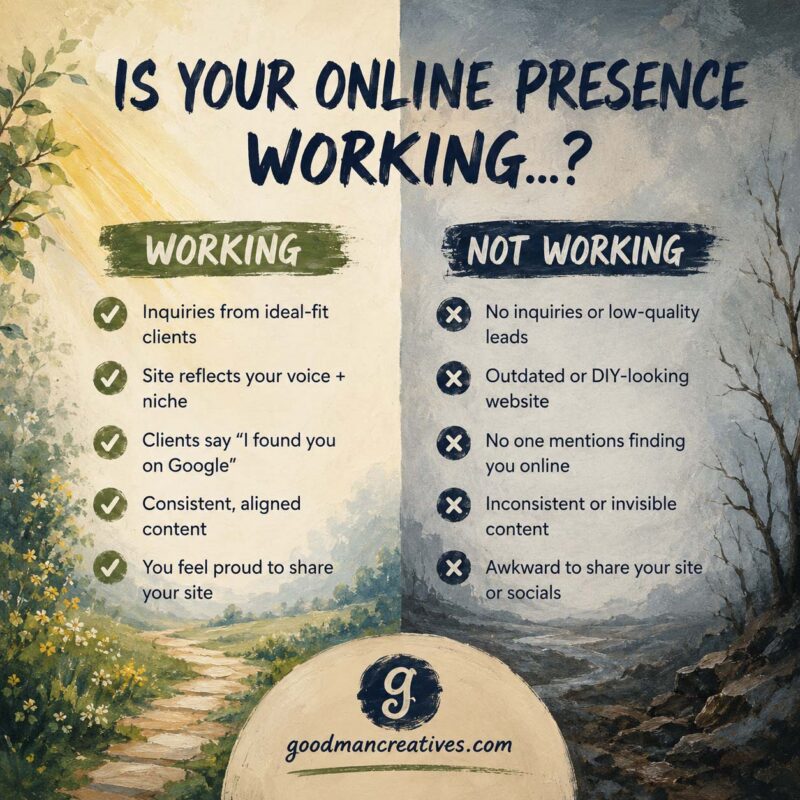
- You’re not getting inquiries, or they’re from clients who aren’t a good fit.
- No one ever says, “I found you on Google” or “I saw your Psychology Today profile.”
- You have no idea where your traffic is coming from, or if anyone’s visiting your site at all.
- Your social posts get little or no engagement (despite the time you spend crafting them).
- You feel awkward sharing your website because it feels outdated, off-brand, or just not “you.”
If even one of those sounds like your experience, it might be time to pause and reassess. Not to judge yourself. Not to spiral into “I’m doing it all wrong” energy. Just to get curious.
First, step back and look at your online presence the same way a potential client might. And from there, you can start making small, intentional shifts.
What Does “Working” Actually Mean for a Therapist?
Let’s take a breath and reframe. Before you can evaluate whether your online presence is working, you need to define what “working” actually looks like for you.
For most solo and group therapy practices I work with, success looks like:
- Inquiries from clients who feel like a great fit.
- Hearing “I found you online” during intake calls.
- A website that genuinely reflects your voice, values, and niche.
- Feeling proud (or at least peaceful) when you share your site or socials.
- Showing up in search results for the kind of therapy you offer.
In other words, your online presence feels like an extension of your practice. It represents you clearly, it resonates with the people you want to reach, and it quietly supports the work you’re here to do.
Notice what’s not on that list …
❌ You don’t need thousands of Instagram followers.
❌ You don’t need to blog every week.
❌ You don’t need a flashy brand or expensive SEO package.
You just need enough of the right people finding their way to you, and feeling that moment of “yes, this therapist gets me” feeling. That’s the sweet spot.
Why Your Online Presence Might Not Be Working
Real talk: Even the most skilled, compassionate therapists can struggle with visibility online.
It’s not because you’re doing something wrong. It’s usually because something in your digital ecosystem is out of sync with who you are or who you’re trying to reach. Here are some of the most common reasons I see:
Your messaging isn’t speaking to your ideal client
Maybe your website still says you work with “everyone”, but these days, your heart is in trauma work or couples therapy. If your words don’t clearly name who you help and how, it’s easy for the right people to scroll past.
Your website feels outdated or off-niche
Design matters more than we want it to. If your site looks like it hasn’t been touched in years (or was clearly DIY’ed in a weekend), potential clients might assume your practice is out of sync too, even if that’s not true.
Your Google Business Profile or directory listings are incomplete
This one’s so easy to miss. An outdated Google Business address, missing hours, or inconsistent service descriptions across Psychology Today, TherapyDen, etc., can confuse Google (and clients) and lower your chances of showing up in search.
Your content is invisible or inconsistent
Maybe you post something deep on Instagram once a month… and then ghost for a while. Or you wrote three great blog posts two years ago and never touched it again. (It’s okay. You’re not alone.) Search engines love consistency, and so do potential clients.
You’re trying to do it all yourself
This one hits home for a lot of therapists. You’re the website manager, content writer, SEO strategist, and social media scheduler, all while holding space for clients every day. It’s a lot. And burnout is real.
Tools to Check if Your Online Presence is Working
Before you make any changes, it helps to understand what’s already out there.
Think of this as a gentle, curiosity-led self-audit. These free tools can help you see your online presence the way a potential client might.
Google Yourself (in Incognito Mode)
This might sound basic… but it’s one of the most eye-opening steps you can take.
Here’s what to do:
Open an incognito window in your browser (so your search history doesn’t influence the results) and type in your name along with terms a client might use when looking for someone like you.
Try phrases like:
- “Your Name therapist”
- “Your Name LMFT”, “Your Name LCSW” (or your credentials)
- “Therapist in [Your City]” or “Trauma therapist [Your City]”
Then take a breath, and notice:
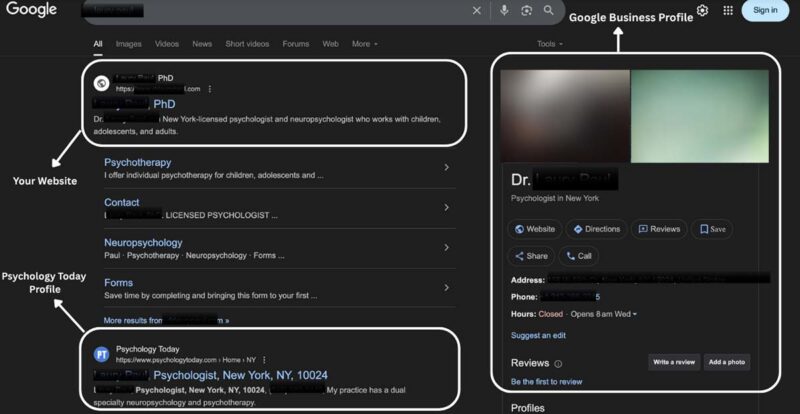
- What shows up first? Your Psychology Today profile? Your website? A random blog post from 2014?
- Do you have a verified Google Business profile with 5-star Google reviews?
- Are the results clear, relevant, and up to date?
- Would a potential client get a good first impression from what they see?
This is exactly what your future clients are doing when they hear your name or find you in a directory.
It’s often their first moment of contact with you, before they’ve clicked a single link.
If what you see doesn’t feel aligned, that’s not a failure. It’s just information, a starting point for tuning your digital presence to better reflect who you are today.
Check Your Google Business Profile
If you’ve ever searched for a local restaurant or doctor on Google and seen that little info box pop up on the right side, with hours, reviews, directions, and a “call now” button, that’s a Google Business Profile.
And yes, therapists can (and should) have one too.
Why it matters:
Your Google Business Profile helps clients find you in local searches and on Google Maps.
It’s often the very first thing people see, especially if they search for “therapist near me” or type your name directly into Google.
Here’s what to check:
- Is your profile claimed and verified? (You can visit google.com/business to check or claim it.)
- Are your hours, location, phone number, and services up to date?
- Do you have a short, clear description of your practice?
- Are clients or colleagues leaving reviews?
Not gonna lie, many therapists skip this step or forget to maintain it. But it’s one of the simplest, highest-impact things you can do to improve your online presence.
Website Check
Your website doesn’t have to be perfect. But it does need to do its job, helping potential clients quickly understand who you are, who you help, and how to take the next step.
Here’s a simple way to start:
Does your website pass the “5-second test”?
That means: if a total stranger landed on your homepage, could they answer these three questions in five seconds or less?
- Who is this therapist for?
- What kind of therapy do they offer?
- How do I contact them?
If not, you may be losing people before they even start reading.
Next, check these basics:
- Is your site mobile-friendly? (More than half of your visitors will find you on their phones.)
- Is it easy to contact you, or would it be better to book a consultation?
- Do your photos, colors, and words reflect your personality and niche?
What matters most is clarity and connection … making it easy for someone to land on your site and feel that quiet, hopeful moment of “Maybe this person can help me.”
Ask a friend or colleague to visit your site and narrate their experience out loud. Notice where they get confused, pause, or have questions. That feedback is gold.
Free SEO Tools
Let’s be honest, the term “SEO” (Search Engine Optimization) can feel intimidating. But at its core, SEO just means helping Google understand who you are and what you offer, so it can connect you with people searching for help.
And the good news? You don’t need to be an expert. There are simple, free tools that can give you real insight into how your site is performing.
Here are two to try (with some honest notes on their limitations):
Screenshot of Ubersuggest dashboard
Mockup of Ubersuggest’s keyword or traffic view, with a few simple labels for context.
1. Ubersuggest
Ubersuggest is a free tool that offers a beginner-friendly snapshot of how your website is showing up online. With Ubersuggest, you can:
- See your estimated monthly organic traffic (though it’s not super in-depth or historical, just a general ballpark)
- Check your domain authority (a number that gives you an idea of how strong your site appears to Google)
- View the top 20 keywords that are driving traffic to your site or individual pages
What it doesn’t do (at least for free):
- It won’t directly tell you if your pages are being indexed by Google. Instead, it offers a site audit feature, which highlights some technical SEO issues like missing meta descriptions or slow page speed.
But be aware: the free version only shows a few results. For example, if 19 pages are missing descriptions, it might only show 4–5 of them. Still, for a quick scan of what’s working (and what’s not), Ubersuggest is a gentle entry point.
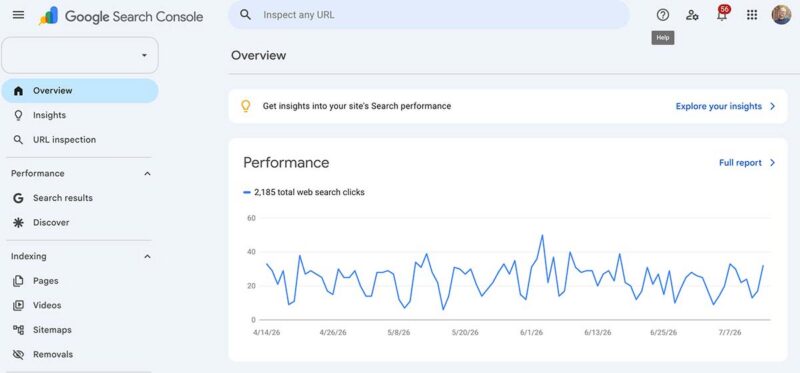
2. Google Search Console
This tool comes straight from Google, and once it’s set up, Google Search Console can offer deep insight into how your site is performing in search results.
Highlight clicks, impressions, and top search terms, keep it clean and beginner-friendly.
It can show you:
- What search queries people are using to find you
- Which pages are getting clicks
- Whether Google can properly read, crawl, or index your pages
A quick heads-up:
Setting it up doesn’t require coding, but it does ask you to verify ownership of your website.
If that phrase alone makes your eyes glaze over, I get it. You don’t need to be a tech expert, but having a basic understanding of your site’s structure (or a web person you can lean on) will help.
Social Media Check
Social media doesn’t have to be your full-time job. But if you’re using platforms like Instagram, Facebook, or even Threads to support your practice, it’s worth checking in on how they’re functioning.
Here’s what to look for:
- Are your bios current and clear?
Do they quickly explain who you help and how? Is your link working? Does it lead to your website, a contact form, or a Linktree-style page with options? - Are your posts consistent?
It doesn’t mean daily content. But if your last post was nine months ago, a potential client might wonder if you’re still practicing. - Is your tone and imagery aligned with your practice?
Do your posts feel authentic? Do they reflect the kind of work you do and the space you create for clients?
Think of your social feed like a waiting room. Even if someone doesn’t engage, they’re observing. They’re sensing your presence. They’re deciding if you’re someone they can trust.
Ask Your Clients
This one’s simple, but surprisingly powerful. Just ask: “How did you find me?”
You can include it in your intake form. Or ask casually during a consult or first session, if it feels appropriate. Here’s why it matters:
- You’ll get real-world data about what’s actually working (and what isn’t)
- You might learn that a client found you through a blog post, a friend’s share on social, or an old podcast interview you forgot about
- It helps you stop guessing, and start making decisions based on what your actual clients are responding to
What to Do if It’s Not Working
So you’ve done a little audit. You googled yourself. You looked at your website, your socials, maybe even peeked into some SEO tools.
And now you’re realizing, something’s not quite clicking. Your online presence isn’t reflecting the full depth of your work, or bringing in the kind of clients you love supporting. That’s okay. What you’re noticing is simply feedback … a signal that something might need adjusting, not a reflection of your worth or effort.
Here are some simple, doable ways to start bridging the gap.
Refresh your website to reflect your voice and niche
If your website feels generic, outdated, or just not you anymore, you’re not alone. A lot of therapists create their first site while still figuring out their niche, and never quite circle back once things settle.
A refresh can look like:
- Updating your homepage copy so it clearly speaks to your ideal client
- Swapping out stock photos for something more grounded or personal
- Making sure your bio sounds like your actual voice, not a résumé
- Adjusting colors, fonts, or layout so it reflects your current vibe
The goal is to have a site that feels like a natural extension of your work … something that reflects who you are and how you help.
Claim and optimize your Google Business Profile
If you haven’t claimed your Google Business Profile yet, or it’s been a while since you looked at it, this is one of the simplest ways to improve your local visibility.
When someone searches “therapist near me” or types your name into Google, this is the little info box that can appear with your name, website, hours, location, phone number, and even reviews.
A well-maintained profile can help you:
- Show up in local search results and Google Maps
- Build credibility with potential clients (especially if you have reviews)
- Make it easy for people to contact you directly from the search page
Revisit your Psychology Today (or other directory) bio
Your directory profile is often the first point of contact for potential clients. But let’s be honest, it’s easy to “set it and forget it.”
If it’s been a while since you looked at your Psychology Today, TherapyDen, or other profiles, take a few minutes to read them through with fresh eyes.
Ask yourself:
- Does this still reflect the kind of clients I want to work with?
- Is my language clear, warm, and client-centered, or is it full of clinical terms or vague statements?
- Have I mentioned my specialties, modalities, or any new training I’ve done?
- Is my photo current and professional (but still human and approachable)?
Try reading your profile out loud. If it doesn’t sound like something you’d actually say to a client in a first session, it might be time for a little tune-up.
Ask satisfied clients (where appropriate) to leave reviews
I know this one can feel a little vulnerable. But when done ethically and thoughtfully, inviting reviews is one of the most powerful ways to build trust with potential clients.
Why? Because people want to know they’re not alone. They want to see that others have worked with you, felt safe, and experienced something meaningful.
Here’s how to approach it:
- Choose clients you feel have had a positive, trusting relationship with you, and who you believe would be open to the ask
- Make it low-pressure: “If you ever feel comfortable leaving a short review, it would help others feel safe reaching out too”
- Give them the direct link (Google, Psychology Today, etc.) so it’s easy
A review doesn’t need to be long or specific. Even a sentence or two, “I felt heard and supported”, can make a huge difference to someone deciding whether to take that first step.
Consider whether your message is clear and client-centered
This has more to do with your words than your design. When a potential client reads your website, directory profile, or even your Instagram bio, can they quickly understand:
- Who you help?
- What you help with?
- How you help them feel better?
If your messaging is too broad, overly clinical, or focused on credentials instead of connection, it can create distance, even if the work you do is deep and powerful. Try shifting your lens from “What do I do?” to “What does my client need to hear in order to feel safe reaching out?”
Here’s a simple rewrite example:
❌ “I use an integrative, strengths-based approach grounded in DBT and somatic techniques.”
✅ “You don’t have to go through this alone. Together, we’ll explore what’s underneath the anxiety and find real ways to help you feel more steady.”
Try batching social content to stay consistent
Posting on social media can feel like a full-time job, especially when you’re trying to create everything on the fly. That’s where batching comes in.
Instead of scrambling for something to post each week (or feeling guilty when you don’t), try setting aside one focused hour to create a small batch of posts in advance.
You don’t need a complex system. Just:
- Jot down 3–5 gentle reflections, tips, or validating messages you’d share with a client
- Turn them into simple captions or graphics
- Schedule them using a free tool (like Later or Buffer) or post manually when you’re ready
The goal isn’t to “go viral.” It’s to show up consistently, in a way that feels sustainable and true to your voice.
Make small SEO improvements
Search Engine Optimization (SEO) doesn’t have to be overwhelming. You don’t need to become a tech expert, but making a few small adjustments can help Google connect your site with the people searching for support.
Here are a few simple ways to begin:
- Use plain, natural phrases like “anxiety therapist in [your city]” on your homepage and about page
- Make sure each page has a clear headline (that’s what Google reads first)
- Add a few internal links, for example, linking from your homepage to your services or contact page
- Include your full name, credentials, and location at the bottom of your site
These small shifts help Google understand who you are and where you are, which makes it more likely to show your site to someone nearby looking for support.
Start a blog or resources page
When you have the capacity, sharing something thoughtful and true to your voice can go a long way. However, there is no need to be constantly creating. You can start with a blog or resource page where you post on a weekly or bi-weekly basis.
A blog or resources page can:
- Answer common client questions before they reach out
- Offer grounding tools or reflections between sessions
- Help your site show up in search results (since Google loves fresh content)
- Build trust by showing your tone, personality, and way of thinking
Not sure what to write about? Try starting with:
- “What to expect in your first therapy session”
- “How to know if therapy is right for you”
- “3 ways I help clients feel more grounded in anxious moments”
Perfection isn’t the goal. Write like you’re talking to one person, someone who’s sitting with uncertainty, wondering if they should reach out.
Use Google Ads to boost local visibility
If your website isn’t showing up in search results, or you’re in a highly competitive area, Google Ads can be a helpful way to bridge the gap.
With the right setup, your practice can appear at the top of Google when someone searches things like “therapist near me” or “anxiety therapy in [your city].” It’s one of the fastest ways to get in front of people who are actively looking for support.
But let’s be honest…
Google Ads requires expertise. It’s not just “set it and forget it.” There are keywords to research, locations to target, negative terms to block, copy to write, and budgets to manage.
And it can get expensive, especially if your campaign isn’t optimized. If you’re not careful, you could end up spending hundreds without a single inquiry.
That’s why many therapists choose to work with someone who understands both the clinical space and the ad platform. Someone who can help you run a lean, ethical campaign that prioritizes connection over clicks.
If you’re curious about trying Google Ads but feel nervous about wasting money, that’s valid. Start with a tiny budget, even $5/day, and watch closely. Or reach out for support before diving in.
If it’s overwhelming, get support from people who know this space
Real talk?
Most therapists weren’t trained in marketing. And trying to figure it all out, websites, SEO, ads, social media, branding, on top of running a full practice? That’s a lot.
If you’re feeling stretched, frozen, or just plain tired of Googling your way through it, that’s okay. You’re not behind. You’re not broken. You’re just human.
This is where support can make all the difference, especially support that’s grounded in your world, your ethics, and your values as a healer.
Whether that means:
- Working with a web designer who understands therapy
- Collaborating with a coach or consultant for strategy and mindset
- Or partnering with someone (like Goodman Creatives) for done-for-you help, à la carte or through the $300K Practice Foundation Program
You get to choose the level of support that feels right. The goal isn’t to outsource your voice. It’s to make space for your brilliance to shine through, without burning out in the process.
A Note About Measuring Success (Without Stressing Over Metrics)
Let’s be honest: Tracking numbers probably isn’t why you became a therapist. You didn’t get into this work to analyze bounce rates or worry about conversion percentages. You got into it to help people heal.
But a little clarity can go a long way. You don’t need to become a marketing expert, or check your stats every day. But knowing where your traffic comes from and what your site is doing can help you make smarter, more empowered decisions about where to focus your energy.
Here’s the sweet spot:
- Enough data to guide your next steps
- Not so much that it triggers overwhelm or perfectionism
Start simple.Notice which directories send traffic. Ask clients how they found you. See if people are actually clicking the link in your Instagram bio.
You don’t need all the data … just the kind that answers the question: “Is this helping the right people find me and feel safe enough to reach out?” That’s your metric. That’s your compass.
Final Thoughts
By now, you’ve seen what a “working” online presence looks like, and how to tell if yours is doing its job. You’ve explored practical tools, identified potential gaps, and (hopefully) found a few ideas that feel doable.
So now comes the real question: What will you do with that insight? Not someday. Not when everything’s perfect. Just one small action. Today, or sometime soon. Maybe you:
- Update a sentence on your homepage
- Ask one client how they found you
- Claim your Google Business Profile
- Reach out for support (if that feels aligned)
You don’t need to overhaul your entire digital presence overnight. You just need to take the next right step for your practice, and keep moving forward from there.
 Greg Goodman: