
Every solo therapist and group practice with an in-person office location should claim and maintain their Yelp profile.
Over the years, I’ve had countless conversations about Yelp. Some practices swear by it. Others refuse to touch it. And if you spend a few minutes searching online, you’ll quickly find no shortage of horror stories from business owners who believe Yelp buried their reviews or pressured them into advertising.
So… what’s the truth?
If you have an office location: Yelp is still an important part of your online presence. It can strengthen your local SEO, reinforce trust with Google and AI search engines, and help validate your practice across the web. But, I don’t paying recommend Yelp ads.
Online-only therapists: Yelp requires businesses to have a physical office or to serve customers in within a defined service area. If your practice is 100% virtual, you can’t set up a Yelp profile.
In this article, we’ll talk about why every therapist should have a Yelp profile, how Yelp actually works, the pros and cons of advertising, and where I think Yelp fits into a modern marketing strategy for therapists.
Key Facts at a Glance
- Yelp reviews can strengthen your online trust and local SEO.
- Apple Maps displays Yelp reviews for many businesses.
- AI search engines increasingly use third-party review sites like Yelp as trust signals.
- I rarely recommend paying for Yelp advertising.
- Google Business Profile should almost always be your first priority.
Why Yelp Still Matters
Ten years ago, therapists actually found clients through Yelp. When I was head of marketing at Well Clinic in San Francisco, we used Yelp and Yelp advertising exclusively to grow to a group practice of 40+ clinicians.
Today, that happens much less often.
Most people searching for a therapist start with Google, Google Maps, or increasingly, AI search engines like ChatGPT and Google’s AI Overviews.
So why bother with Yelp?
Search engines don’t just evaluate your website anymore. They evaluate your entire online reputation.
That includes your Google Business Profile, directory listings, online mentions, backlinks, citations, and yes… Yelp.
Even if a prospective client never visits Yelp directly, Google certainly knows your Yelp profile exists. Apple Maps also displays Yelp ratings and reviews for many businesses, and AI search engines increasingly reference third-party review websites when deciding which businesses appear trustworthy.
In other words, Yelp has become less about generating traffic and more about reinforcing credibility across the web.
Yelp Helps in the AI Search Era
Yelp isn’t just another business directory anymore.
As AI search engines like ChatGPT, Google AI Overviews, Gemini, and Perplexity become more popular, they’re looking beyond your website to determine which businesses appear trustworthy. Reviews, business directories, citations, and mentions across the web all help establish credibility.
That’s one of the biggest reasons I still recommend maintaining your Yelp profile. It may not become your biggest source of new clients, but it reinforces the trust signals that both traditional search engines and AI search engines use when evaluating your practice.
How Yelp Works
Before deciding whether Yelp deserves your attention, it helps to understand what Yelp actually is.
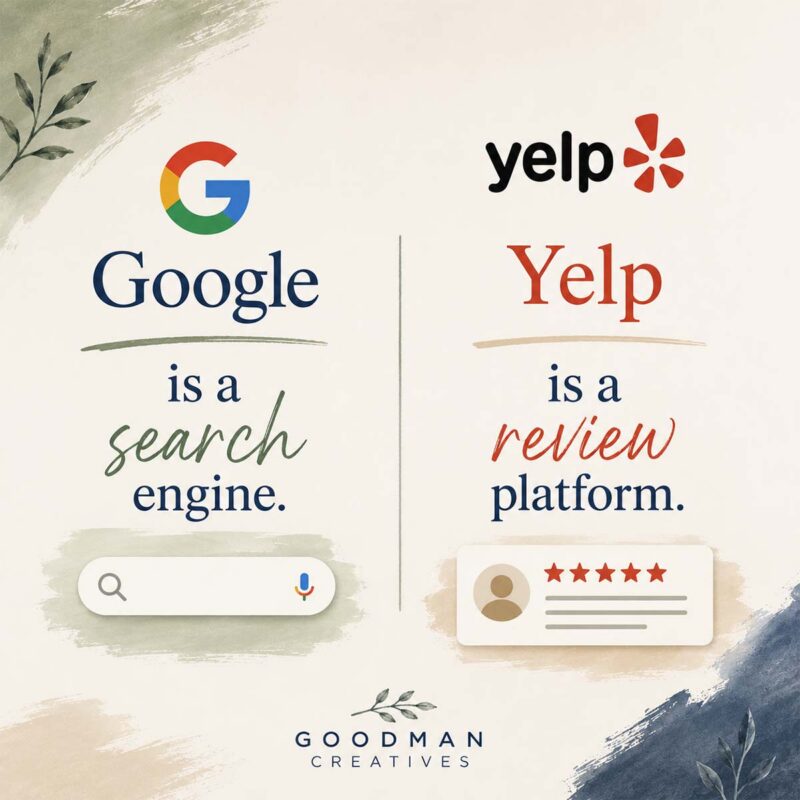
Google is a search engine.
Yelp is a review platform.
While Google tries to organize the entire internet, Yelp is focused on helping people discover and compare local businesses. Therapists, restaurants, dentists, attorneys, plumbers, coffee shops … they’re all competing for visibility inside the Yelp ecosystem.
When someone searches for a therapist on Yelp, the platform looks at a variety of factors before deciding which practices to show. While Yelp doesn’t publicly disclose its ranking algorithm, businesses with more complete profiles, stronger review histories, accurate business information, quality photos, and consistent activity generally have an advantage.
A typical Yelp profile includes:
- Overall star rating
- Total number of reviews
- Business description
- Therapy specialties and business categories
- Office address, hours, and contact information
- Website link
- Office and team photos
- Questions & Answers
- Individual customer reviews
Unlike Google Business Profile, Yelp is much less focused on ongoing posts, updates, products, or services. The profile itself remains fairly static. Client reviews are still the biggest driver of credibility and visibility on the platform.
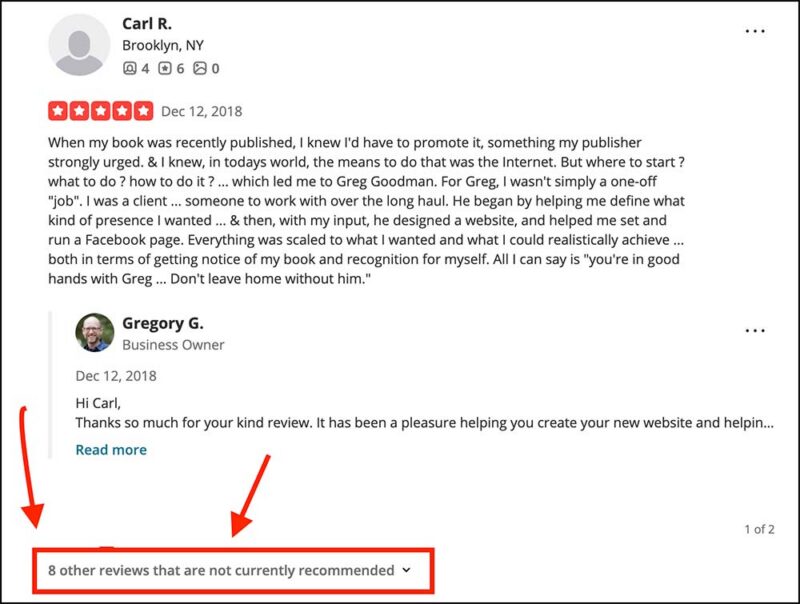
Warning – Yelp doesn’t display every review it receives.
It uses what’s called a recommendation algorithm to decide which reviews appear publicly and which ones get filtered into a section called “Not Recommended.”
According to Yelp, this helps reduce fake reviews and spam.
The frustrating part is that perfectly legitimate reviews sometimes get filtered, especially if they’re written by someone who just created a Yelp account or rarely uses the platform.
I’ve seen therapists receive authentic reviews that never become visible, while other reviews appear almost immediately. Heck, half of MY legitimate Yelp reviews for Goodman Creatives are buried as “not recommended.” Those are real people!
How to Optimize Your Yelp Profile
If you’re going to claim your Yelp profile, you might as well do it right.
An incomplete Yelp profile doesn’t do much for your practice. A fully optimized profile, on the other hand, sends stronger trust signals to prospective clients and helps create consistency across the web. While I still recommend making your Google Business Profile your top priority, it only takes a few minutes to optimize your Yelp listing.
Here’s what I recommend.
Complete Every Section of Your Profile
Yelp rewards complete business profiles. Take the time to fill out every field you can. The more complete your profile is, the more trustworthy it appears to both potential clients and search engines.
Upload High-Quality Photos
Photos are one of the easiest ways to make your profile stand out. Always include bio photos, headshots, logos, and office photos (if possible). If you’re online only, snap images of the details of your home office. Things like your diploma, your plants, your laptop, etc. Here’s a guide on setting up a therapist photo session.
Write a Helpful Business Description
Your business description should explain who you help, what types of therapy you provide, and what makes your practice unique.
This is also a good place to naturally mention the services you offer and the communities you serve. Avoid stuffing your description with keywords. Write for people first.
Choose the Right Categories
Make sure your primary business category accurately reflects your practice.
If appropriate, add additional categories that describe your services, but don’t select categories simply because they’re available. Relevance is more important than quantity.
Keep Your Information Consistent
Your practice name, address, phone number, and website should match what’s listed on your Google Business Profile, Psychology Today, Apple Maps, Healthgrades, and other directories.
This consistency, often called NAP consistency (Name, Address, and Phone Number), helps search engines feel more confident that all of those listings represent the same business.
Add Reviews Slowly Over Time
If you decide to build reviews on Yelp, avoid trying to get a large number all at once. Yelp’s recommendation software has a reputation for filtering reviews from new or inactive users, especially when multiple reviews appear in a short period of time.
A handful of authentic reviews earned gradually over time is generally a much healthier approach than trying to collect twenty reviews in a single week.
Keep Your Profile Up to Date
Don’t claim your Yelp profile and forget about it. If you move offices, change your phone number, hire a new therapist, update your office photos, or expand your services, update your Yelp profile as well. An accurate profile is more helpful to potential clients and sends stronger trust signals across the web.
How Advertising Works on Yelp
Yelp Ads work very differently than Google Ads.
With Google Ads, you’re bidding on specific search terms like therapist near me or EMDR therapist. Yelp works more like a promoted business directory. You’re paying to make your Yelp profile more visible throughout the Yelp platform.
Depending on your market and advertising package, Yelp Ads can:
- Appear at the top of Yelp search results as a Sponsored listing.
- Show your practice on the profiles of competing therapists.
- Display your business for related mental health searches, not just your primary category.
- Promote your business through the Yelp Ad Network on partner websites.
- Highlight selected photos, reviews, and calls-to-action to encourage more clicks.
- Charge you on a cost-per-click (CPC) basis, meaning you only pay when someone clicks your ad.
Ad Reporting is Sub-Par on Yelp
One of Yelp’s biggest selling points is its reporting dashboard. After you start advertising, Yelp provides estimates for a variety of performance metrics, including:
- Ad impressions
- Profile views
- Website clicks
- Phone calls
- Direction requests
- Messages sent through Yelp
- Customer leads
On the surface, it looks very similar to Google Ads. The difference is how those results are measured.
With Google Ads, we can install Google Analytics, connect call tracking software, track form submissions, integrate with a CRM, and often follow a lead all the way through the sales process. That gives us multiple ways to verify exactly where new clients are coming from and whether our advertising is producing a positive return on investment.
Yelp also offers reporting, including call tracking for advertisers. However, I’ve never found it to provide the same level of transparency or independent verification that Google Ads does.
I’m not suggesting Yelp’s reporting is inaccurate.
I’m simply saying that when I’m helping a therapist decide where to invest their marketing budget, I want data I can independently validate. In my experience, that’s been much easier to do with Google Ads than with Yelp.
Pros and Cons of Yelp Advertising
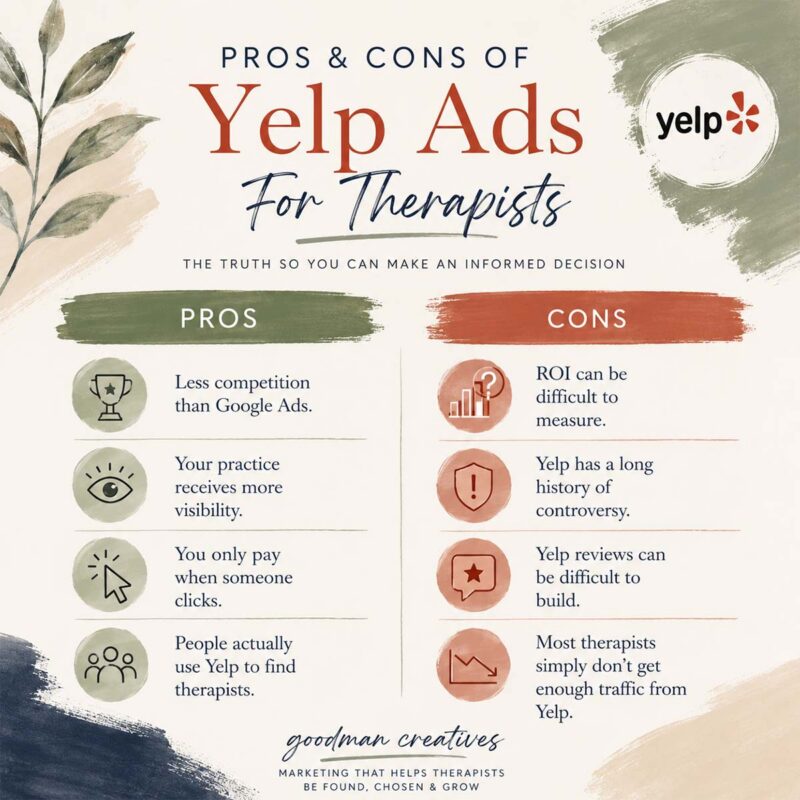
Like almost every marketing platform, Yelp advertising has both advantages and disadvantages.
I’ve seen therapists have success with Yelp Ads. I’ve also seen therapists spend thousands of dollars with very little to show for it. (Though, TBH, I could say the same thing about Google Ads, Meta Ads, and any other advertising platform).
Whether it’s worth the investment depends on your market, your competition, your budget, and how you measure success.
Pros
- Your practice receives more visibility. Yelp Ads place your profile higher in search results and can even display your practice on the profiles of competing therapists.
- Less competition than Google Ads. While Google Ads has become increasingly competitive, relatively few therapists actively advertise on Yelp. In some markets, that can create opportunities.
- You only pay when someone clicks. Yelp uses a cost-per-click (CPC) model, so you’re paying for engagement rather than simply displaying your ad.
Cons
- The return on investment can be difficult to measure. While Yelp provides reporting, I’ve never found it as transparent or as easy to independently verify as Google Ads.
- Yelp has a long history of controversy. For years, business owners have questioned Yelp’s review filtering and advertising practices. (see below for more)
- Yelp reviews can be difficult to build. Because Yelp aggressively filters reviews from new or inactive users, even legitimate reviews may never become publicly visible.
- Most therapists simply don’t get enough traffic from Yelp. For many private practices, the number of leads generated through Yelp isn’t enough to justify making it a primary marketing channel.
The Yelp Review Controversy
If you’ve researched Yelp for more than five minutes, you’ve probably come across stories from business owners who believe Yelp manipulates reviews.
The most common claim is that businesses stop advertising and suddenly some of their positive reviews disappear or are moved into Yelp’s “Not Recommended” section.
Yelp has consistently denied these allegations. According to Yelp, its recommendation software is completely automated, applies the same standards to advertisers and non-advertisers, and does not consider whether a business pays for advertising. Yelp also states that reviews may be filtered if they appear to be solicited, come from inactive users, or otherwise don’t meet the platform’s trust signals.
Over the years, Yelp has also faced lawsuits and regulatory scrutiny over these allegations. To date, courts have generally ruled in Yelp’s favor, and the Federal Trade Commission closed its investigation without taking enforcement action.
That said, the complaints haven’t gone away.
Personally, I’ve seen enough strange things happen over the years that I understand why many business owners become frustrated. I’ve also seen legitimate reviews filtered for reasons that were never explained.
Can I prove Yelp is intentionally manipulating reviews based on whether someone advertises?
No.
Would I base an important marketing decision solely on rumors?
Also no.
But I do think therapists should understand why Yelp has developed this reputation among many small business owners. It’s one of the reasons I recommend claiming your Yelp profile, keeping it updated, and treating Yelp advertising as an experiment rather than a long-term marketing strategy.
FAQs
Do Yelp Ads Work For Therapists?
One thing I found interesting while researching this article is that there doesn’t appear to be any publicly available data on how well Yelp Ads perform specifically for therapists.
Yelp publishes advertising success stories and overall lead statistics across all industries, but I couldn’t find any independent research looking specifically at private practices or mental health professionals. That’s another reason I tend to be cautious.
When I’m recommending a marketing strategy to a therapist, I want evidence that it works for therapists … not just for plumbers, movers, or restaurants.
Can online therapists have Yelp?
Generally, no. Yelp is designed for businesses that serve customers at a physical location or within a local service area. Fully virtual practices usually aren’t eligible.
Is Yelp good for SEO?
Yes. While Yelp may not send a large amount of traffic, it strengthens your online presence and serves as another trusted citation that can support your local SEO and AI visibility.
Does Apple Maps use Yelp?
Yes. Apple Maps displays Yelp ratings and reviews for many local businesses, making Yelp more influential than many therapists realize.
Can Yelp remove reviews?
Yelp typically doesn’t remove reviews unless they violate its content guidelines. However, its recommendation software may move reviews into the “Not Recommended” section, making them much less visible.
Why are my Yelp reviews hidden?
Yelp’s recommendation software automatically filters reviews it considers less trustworthy. Reviews from new or inactive Yelp users are more likely to be hidden, even if they’re completely legitimate.
Can I ask clients for Yelp reviews?
Yelp discourages businesses from asking customers for reviews, and therapists should also consider the ethical guidelines of their licensing board before requesting reviews from clients.
Can I respond to therapy client reviews on Yelp?
You should avoid responding in a way that confirms someone is your client or discloses protected health information. Even a well-intentioned response can create HIPAA concerns. The safest approach is to respond in general terms or not respond at all.
How many Yelp reviews do I need?
There’s no magic number. For most therapists, even five to ten authentic reviews can help establish credibility. I’d focus on building Google reviews before trying to grow your Yelp review count.
What’s better, Yelp or Google Business Profile?
Google Business Profile. If you only have time to optimize one platform, make it Google. It’s far more important for local SEO, Google Maps, and attracting new clients. Yelp should be viewed as a supporting platform, not your primary marketing channel.
My Final Thoughts
Yelp isn’t dead.
It’s just not the marketing powerhouse it once was.
If you’re a therapist with a physical office, I absolutely recommend claiming and optimizing your Yelp profile. It’s another important trust signal that helps strengthen your online presence and reinforces your credibility with Google, Apple Maps, and AI search engines.
Would I recommend making Yelp Ads the foundation of your marketing strategy?
Probably not.
If your Google Business Profile isn’t fully optimized, your website isn’t generating traffic, or you’re still working to build your Google reviews, that’s where I’d invest my time and money first. Once those pieces are in place, there’s nothing wrong with experimenting with Yelp Ads to see how they perform in your market.
Need Help Growing Your Private Practice?
At Goodman Creatives, we specialize exclusively in digital marketing for therapists, psychologists, psychiatrists, and group practices. From SEO and Google Ads to website design, AI search optimization, and Google Business Profile optimization, we help mental health professionals attract more of the right clients without wasting money on marketing that doesn’t work.
If you’re ready to grow your practice, schedule a free consultation and let’s talk about what’s actually worth investing in … and what isn’t.
 Greg Goodman: