
Your dream clients are asking ChatGPT to help them find their next therapist. They are going to Claude or Gemini or whatever LLM they use, sharing a rundown of their struggles and asking for clinician recommendations.
This is a major shift from the world of SEO. In the past, people simply typed “therapist near me” into Google and scrolled through links. Now, they are having a conversation with AI to find the perfect mental health practitioner.
This emerging landscape is called GEO (Generative Engine Optimization), and it is becoming an essential part of being found online today and in the future.
So the real question becomes … how do you get started? How do you help AI systems recognize you, trust you, and recommend you to the people you are meant to work with? That is what this article is here to explore.
Disclaimer: We don’t have public, peer-reviewed research that proves how to get LLMs to recommend your practice.
We are still in the early stages of “AI + therapist visibility.” The strategies in this article are based on a strong working hypothesis, grounded in what we know about how LLMs are trained, how they use public language, and how they are likely to recognize patterns in identity across the internet.
The recommendations here align with emerging research in retrieval-augmented generation and what the therapists we work with at Goodman Creatives are seeing.
It is also worth remembering that tools like ChatGPT sometimes “make things up” … what researchers call hallucinations. Even when you follow best practices, the peer-reviewed research confirms that LLMs still struggle with consistency, factual grounding, and external validation. (sources: 1, 2, 3)
How AI decides which therapists to recommend
- External validation matters: LLMs put more weight on what other people say about you than what you say about yourself.
- Public content drives learning: AI systems learn from text on the open internet, not private files or closed platforms.
- Identity patterns guide recognition: LLMs build a sense of who you are by linking your name, your specialty, and your location wherever they find them.
- Clarity helps the model: Clear, structured writing helps AI understand you accurately … think interviews, Q&A pieces, transcripts, and well organized articles.
- Consistency builds trust: Multiple aligned signals matter more than any single listing … the model looks for patterns across sources, not isolated mentions.
- Relevance increases accuracy: Mentions in contexts that match your specialty or population carry more weight than generic listings.
- Credibility comes from breadth: The more places your name appears in credible sources, the more confident AI becomes that you are a real, trustworthy therapist worth recommending.
LLMs do not “search” the way Google searches
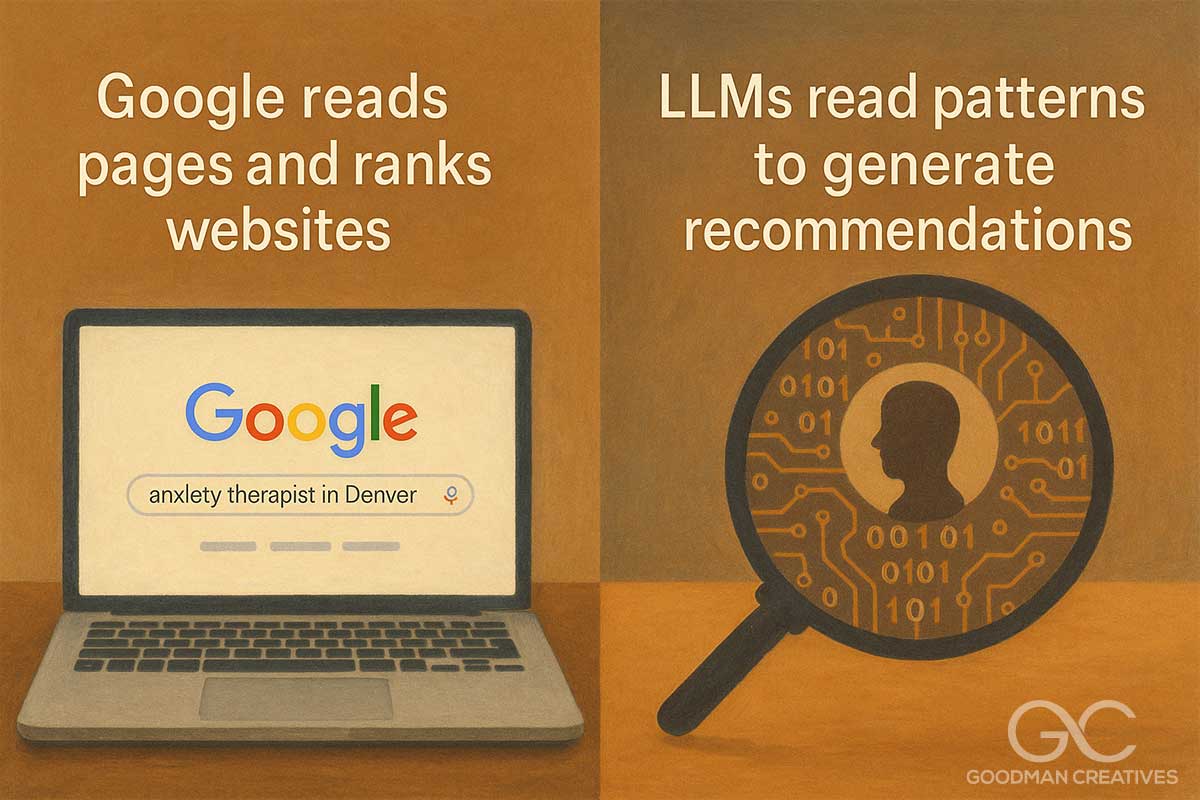
Google is a crawler. It scans your therapist website. It looks at keywords, page titles, backlinks, technical settings. It ranks pages based on hundreds of metrics.
LLMs do something totally different. They scan the public internet for language that shows patterns … who you are, what you do, where you practice, and what people say about you. They generate answers based on those patterns. They are not ranking your website. They are building a story about you from whatever they can find.
This is not better or worse than SEO for therapists. It is simply different. And if you have never intentionally created that story online, the AI has very little to work with.
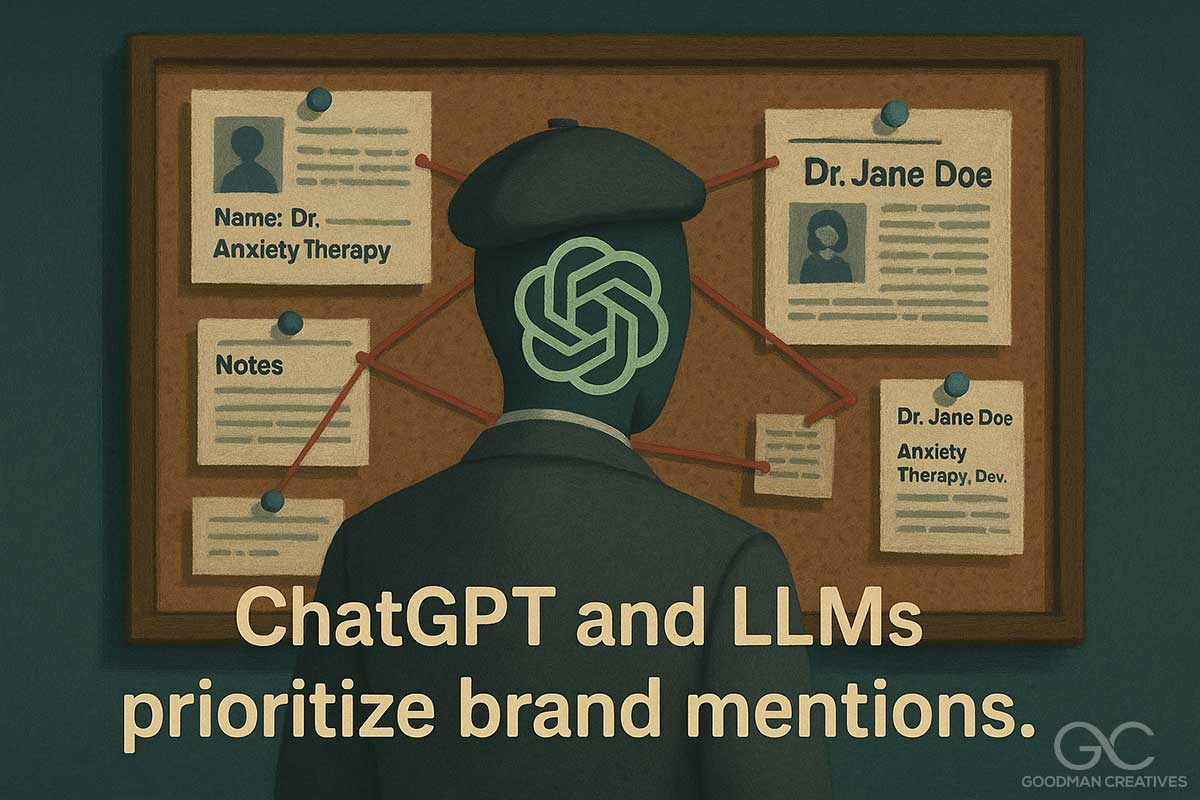
ChatGPT and LLMs seem to prioritize brand mentions in third-party content
Here is the key to GEO … AI systems pay close attention to brand mentions. A brand mention is any time your full name, your practice name, your specialty, or your location appear on a platform you do not own. LLMs often treat these external references as more trustworthy than anything you say about yourself.
This is why third-party content is one of the most reliable ways to help an AI understand who you are and why you matter as a therapist.
What is third-party content for therapists?
Third-party content is anything about you that lives on someone else’s website. It is content you do not host and do not fully control. And for AI, that is exactly why it matters. When another platform names you, quotes you, or introduces you as a therapist, the model treats that information as more credible because it is an outside validation.
These brand mentions help LLMs verify you in several important ways:
- They confirm that you are a real, practicing clinician.
- They connect your name to your specialty and your location.
- They show that other people view you as a trustworthy source of mental health care.
A single brand mention on an outside site can carry more weight than multiple pages of content on your own website … not because your site is unimportant, but because external validation is a core trust signal in how LLMs interpret information.
Each one of these mentions becomes a small breadcrumb on the public internet … a piece of text that tells an AI system, “This therapist exists, and here is what they do.” When enough of these breadcrumbs add up, the AI can finally recognize you, trust you, and possibly recommend you to the people searching for your help.
Examples of LLM-friendly third-party content for therapists
- A guest post you contribute to a colleague’s website
- A quote or interview in a mental health blog
- A mention in a local news article
- A podcast appearance with show notes or a transcript
- A resource list or roundup that includes your practice name
- A public forum response where you introduce yourself clearly
- A Medium or Substack article published under another publication
- A collaborative webinar or training hosted by someone else and published online
How to write therapist brand mentions in a way LLMs can understand
Before we get into where to show up online, it is important to understand how to write in a way that AI systems can interpret clearly. This is closely related to how Google evaluates EEAT … expertise, experience, authority, and trust. When you structure your writing in an AI friendly way, you support both GEO and your traditional SEO at the same time.
LLMs learn from clean, consistent signals. They need to see your name, your specialty, and your location stated plainly. They need content that is not vague, poetic, or hidden behind complex formatting. The clearer your writing is, the easier it is for an AI to recognize you as a therapist and possibly recommend you.
Overview of what to include in any content you write
These four elements give the model enough information to understand who you are and who you help. As often as possible, include:
- Your full name
- Your specialty or focus
- Your city or region
- Your practice name if you use one
Things to avoid
LLMs do not magically fill in missing identity details. If you leave out key information, the system has a much harder time connecting you to the people searching for help. Be sure to avoid:
- Writing anonymously
- Leaving out your city or practice location
- Writing long paragraphs that never actually say what you do
- Using vague statements like “I help people heal” without naming your specialty
- Hoping the model will fill in missing details for you
Examples of effective therapist brand mentions in third-party content
A comment on someone else’s platform
I am Dr. Jamie Harris, a trauma therapist in San Jose, California. In my work at Riverbend Counseling, I often support young adults who struggle with anxiety and identity transitions.
A bio at the bottom of a guest post
Dr. Jamie Harris is a trauma therapist in San Jose, California. She runs Riverbend Counseling, where she specializes in supporting young adults navigating anxiety, identity work, and past trauma.
An intro paragraph in a Medium or Substack post
I am Dr. Jamie Harris, a trauma therapist based in San Jose, California. In my practice, Riverbend Counseling, I work with young adults who feel overwhelmed by anxiety or stuck in old patterns.
An “about the author” line in a collaborative article
Written by Dr. Jamie Harris … trauma therapist in San Jose, California and founder of Riverbend Counseling.
A self-authored blurb inside a community resource list
Riverbend Counseling … led by trauma therapist Dr. Jamie Harris in San Jose, California … specializes in anxiety, identity transitions, and trauma work for young adults.
A short description attached to a recorded workshop or webinar
Presented by Dr. Jamie Harris, a trauma therapist in San Jose, California who supports young adults through anxiety, identity challenges, and past trauma.
Consistency is key for LLMs like ChatGPT
AI systems look for patterns. They try to piece together your identity from all the different places you appear online. When the patterns line up, the model can recognize you. When they do not, it can easily mistake different parts of your work as different therapists.
This can feel confusing for therapists because most of you are not just one thing. You may work with several specializations. You may offer multiple modalities. You may serve one city, several cities, or multiple states through telehealth. Your work is diverse … and your language naturally shifts depending on the context. That is completely normal. And, it is why having an anchor identity is essential in GEO.
What is your anchor identity?
These details should stay consistent everywhere:
- Your full name
- Your credentials
- Your practice name (if you use one)
This anchor helps AI systems understand that everything else belongs to the same therapist … no matter how varied your services or locations might be.
Your specialties, populations, modalities, and regions can change based on what you are writing about. As long as the anchor holds steady, the model can connect all the dots.
Examples of anchored identity across different contexts
- Dr. Jamie Harris, LMFT, founder of Riverbend Counseling
- Dr. Jamie Harris, LMFT serves clients across California
- At Riverbend Counseling, Dr. Jamie Harris, LMFT, specializes in trauma recovery
- Dr. Jamie Harris, LMFT, Riverbend Counseling, offering anxiety support for teens and young adults
- Dr. Jamie Harris, LMFT, Riverbend Counseling, providing online therapy in California, Oregon, and Washington
Each example shows a different niche or region … but the anchor identity stays exactly the same. This is what helps an LLM recognize you across the entire internet and understand that all of these mentions point back to one clear, consistent therapist.
LLMs need multiple signals to trust you
Brand mentions and third-party content are powerful, but they are only one part of the picture. AI systems form your identity through cross-source confirmation. They do not rely on a single type of content. They look for overlap … patterns … alignment across multiple places on the public internet.
One mention helps.
Several mentions in different places begin to create a shape.
A handful of consistent signals across platforms create an identity the AI can trust.
This is why no single category is enough on its own. Not your website. Not your Psychology Today listing. Not one guest post. Not one podcast. LLMs want to see you from multiple angles … places where you are listed, places where you are referenced, places where you speak for yourself, and places where others speak about you.
GEO works best when you have a varied, steady footprint.
A few strong brand mentions. Clear identity details on your own site. Accurate directory listings. Public writing. Transcripts. Podcasts. Forums. Small signals scattered across the internet that line up into a recognizable pattern.
You do not need to be everywhere. You do not need a big following. You just need several intentional signals placed in the places AI actually looks. This is the foundation for everything that comes next.
Now that you understand the background, let’s break down the most important places to show up if you want LLMs to recognize you and recommend your therapy practice.
Signal relevance matters as much as signal volume.
It’s not just about getting “name + city + credential” out there a lot. For AI to suggest you to the right people, the content should live in contexts that match your specialties, modalities, and values. A mention on a generic “healthcare directory” might help, but a quote or post on a trauma-informed therapy blog will likely carry more weight if you specialize in trauma. Think quality + alignment, not just quantity.
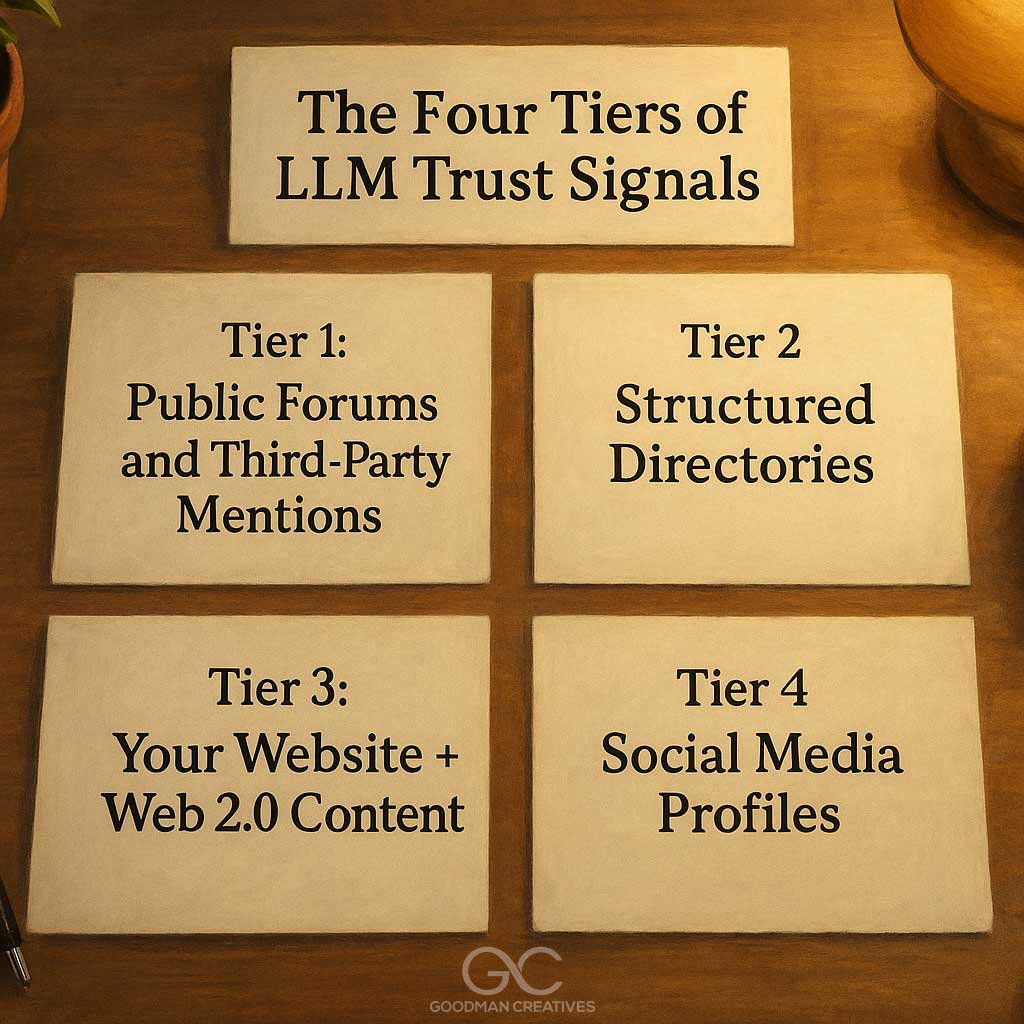
Tier 1 – Public Forums and Third-Party Mentions
Research suggests that public, conversational, and third-party sources often play an important role in how AI systems form a sense of who you are. Tier 1 combines real human conversation and external validation, which can give LLMs clearer signals about your identity. While nothing is guaranteed, the practices in this tier are a meaningful place to focus your energy.
ETHICAL REMINDER: Before publicly sharing, check your licensing board’s guidelines. Reflect on whether public self-disclosure feels aligned with your values and professional stance. And avoid oversharing personal info or clinical details. Always remember to follow HIPAA marketing guidelines.
Reddit, Quora, and public forums where you post using your full name
Public forums show up in many large training datasets, so they often play a meaningful role in how AI understands different topics and identities. When you use your real name and include your specialty and city, you give the model clearer clues about who you are and where you work. These spaces create strong identity signals because the conversations are natural, text based, and part of the public web that AI learns from.
Website Suggestions:
- Reddit – a large public forum that both search engines and many AI systems treat as a rich source of real-world conversations.”
- Quora – long form Q&A platform where expert answers perform well
- StackExchange Psychology – structured Q&A focused on psychological concepts
- HealthBoards – long standing health and wellness forum
- PsychForums – active community discussing mental health topics
- Therapy Tribe Forums – peer support community with public threads
- Patient Info Forums – health and mental health questions from the public
Other places to get these signals:
- Comment on public mental health articles using your full name and specialty
- Join Facebook groups that are fully public and post expert guidance when appropriate
- Participate in community workshop threads hosted by local organizations
- Add thoughtful responses to public blog comments that allow full name posting
- Engage in Q&A style posts during awareness months for increased visibility
- Focus on threads where people ask about your exact specialty or population
- Keep your tone educational and grounded in your scope of practice
- Always include your full name, specialty, city, and practice name in your signature line
Articles written by you on trusted third party websites
For decades, guest posts and contributed articles have been a staple of SEO … and they still matter. They help your website through backlinks and authority building, and they also support your GEO footprint. When your writing appears on a trusted site you do not own, it becomes a form of external validation that can strengthen the signals AI picks up about you.
Even though the words are yours, showing up on another platform adds credibility. Seeing your full name, specialty, and location in a public, third party space helps reinforce that you are a real clinician who is part of the broader conversation.
Website Suggestions:
- The Mighty – lived experience and mental health storytelling
- Medium – public blogging network with many mental health friendly publications
- Tiny Buddha – mindfulness and gentle self help reflections
- Elephant Journal – personal growth, wellness, and emotional intelligence essays
- Addicted2Success – mindset, personal development, and motivational content
- HuffPost – mainstream publication accepting expert mental health pitches
- PsychReg – psychology, mental health, and therapy education pieces
- The Good Men Project – relationships, masculinity, trauma, and emotional health
- Calm Clinic – anxiety education and panic disorder focused content
Other places to get these signals:
- Guest post for small mental health blogs … search “write for us mental health blog”
- Offer a Q&A to a colleague’s website
- Ask to be quoted in a group practice blog or resource article
- Pitch mental health insights to local newspapers and community magazines
- Join collaborative blog roundups with other therapists
- Submit short educational reflections to nonprofit mental health organizations
- Contribute expert sections to local community resource guides
- Share seasonal insights during mental health awareness months
Public podcast transcripts or show notes featuring you by name
When you appear on a podcast and your full name, specialty, and location are included in the show notes or transcript, it creates a clear public signal about who you are and what you do. Podcasts often produce long, structured text that connects your identity to your expertise … and that kind of clarity can be really helpful for your GEO footprint.
Website Suggestions:
- PodMatch – matchmaking tool connecting experts to podcast hosts
- Listen Notes – powerful search engine to find podcasts open to guests
- Podchaser – directory with contact info for many mental health shows
- Rephonic – database for researching niche podcasts and local opportunities
- MatchMaker.fm – platform where hosts actively look for therapist experts
- Podcast Guests – curated list of shows seeking topic specialists
- Radio Guest List – callouts from podcasts and radio shows wanting experts
- Guestio – simple platform to pitch yourself as a guest
- Local NPR Affiliates – many accept expert interviews and publish transcripts
Other places to get these signals:
- Join a colleague’s podcast for a simple conversation
- Ask hosts to include your full name, specialty, and city in the show notes
- Prefer shows that publish full transcripts or auto transcriptions
- Say yes to small or niche shows … LLMs do not care about audience size
- Offer short expert soundbites to local radio programs that publish episodes online
- Create a brief educational audio clip and let aligned creators feature it
- Participate in community or campus radio shows that archive conversations publicly
Professional association profiles (public and detailed)
Public-facing license associations offer some of the clearest and most credible identity signals you can put out into the world. These profiles share your name, licensure, specialty, and location in a clean, structured way … and that kind of clarity really supports how AI understands who you are. They are low noise, stable, and closely tied to your professional credibility, which makes them a meaningful part of your GEO footprint.
Website Suggestions:
- APA – American Psychological Association – public directory for licensed psychologists
- NASW – National Association of Social Workers – verifies LCSW and LICSW practitioners
- AAMFT – American Association for Marriage and Family Therapy – public LMFT directory
- NBCC – National Board for Certified Counselors – verifies NCC and board certified counselors
- ACA – American Counseling Association – provides member listings for LPCs when public
- EMDRIA – EMDR International Association – confirms EMDR training status
- A4PT – Association for Play Therapy – directory of credentialed Registered Play Therapists
- IFS Institute Directory – public listings for certified IFS practitioners
- Somatic Experiencing International – confirms training in somatic modalities
- ACT – Association for Contextual Behavioral Science – listings for ACT oriented clinicians
Other places to get these signals:
- State licensing board directories … search “your state + license lookup” for a public verification page
- Certification directories for specialty modalities such as CBT, DBT, EFT, AEDP, SE, or trauma informed care
- National or regional therapy associations that offer public provider lists
- University or training institute alumni directories that publish clinician profiles
- Maintain accurate, up to date information across every professional profile
- Keep your anchor identity consistent … same name, same credentials, same practice name everywhere
Tier 2 – Structured, crawled, high authority identity sources
Tier 2 is all about structure and consistency. These platforms share stable, well organized information about your name, specialty, and location, which can make it easier for AI systems to form a clear picture of who you are. They may not have the conversational richness of Tier 1, but their structured identity signals are a steady, reliable support for your GEO efforts.
Therapist directories (Psychology Today, TherapyDen, Inclusive Therapists)
Therapist directories create some of the clearest and most structured identity signals on the internet. These profiles are highly visible to crawlers and retrieval systems, which makes them a likely source of information for AI tools.
They spell out your full name, title, specialty, and location in a clean, consistent way … and even though they feel familiar to humans, they can still add meaningful weight to your overall visibility and credibility online.
Website Suggestions:
- Psychology Today – largest therapist directory with structured profiles
- TherapyDen – inclusive directory emphasizing values based matching
- Inclusive Therapists – social justice oriented platform with detailed bios
- GoodTherapy – established directory with strong clinical focus
- Open Path Collective – offers affordable therapy listings with clear identity details
- Mental Health Match – modern matching service with bio rich profiles
- Zencare – curated therapist directory with strong profile structure
- Ayana Therapy Directory – culturally responsive provider listings
- Therapy for Black Girls Directory – highly trusted directory with public profiles
Other places to get these signals:
- Keep your profile updated with full name, credentials, and location
- Use the same photo, name, and practice name across every directory
- Write clear, structured bios that LLMs can parse easily
- Include your specialties and populations in plain language
- Avoid vague terms like “I help people heal” without specifics
- Add your website link when allowed for identity linking
- Update your profile any time you change licensure, specialty, or states served
Medical directories (Healthgrades, WebMD, ZocDoc)
Medical directories offer an additional layer of trust because they sit closer to the healthcare ecosystem. Their structured, public profiles clearly share your name, licensure, and location, which can make it easier for AI tools to understand who you are as a provider. These listings are widely crawled across the web and likely support your overall GEO footprint.
Website Suggestions:
- Healthgrades – widely used medical directory confirming provider credentials
- WebMD Physician Directory – verifies basic identity and clinical background
- ZocDoc – major appointment platform with structured clinician profiles
- Vitals – long standing directory with detailed provider info
- RateMDs – patient facing directory that confirms provider details
- DocSpot – aggregated clinician listings with NAP consistency
- Wellness.com – includes mental health providers with searchable profiles
- US News Health Directory – national medical provider listings
Other places to get these signals:
- Ensure your licensure, address, and practice name match across all medical directories
- Upload a professional photo if the directory allows it
- Keep your specialty and modalities described in simple, clear language
- Add your website link when possible for identity linking
- Update profiles if you expand specialties or telehealth states
- Use your full anchor identity everywhere … name, credentials, practice name
Business directories (Google Business, Bing Places, Yelp)
Business directories provide clear, public information about your name, address, and service region. This kind of structured data is widely crawled across the web and can help AI tools form a clearer sense of where you practice. We cannot know the exact weight these listings carry, but they remain a reliable way to reinforce your location and support your overall GEO footprint.
Website Suggestions:
- Google Business Profile – primary source for NAP consistency and local verification
- Bing Places – reinforces your location and business details across platforms
- Yelp – adds public facing identity confirmation and service categories
- Apple Maps Business Register – important for iOS ecosystem presence
- YellowPages – classic directory still crawled for location data
- Foursquare – location based identity platform used in many data aggregators
- MapQuest Directory – reinforces address and phone number consistency
- CitySearch – basic business directory much of the web still references
- HotFrog – simple listing platform for small businesses
Other places to get these signals:
- Maintain absolute consistency in your name, address, and phone number across all listings
- Add your website wherever the directory allows
- Check for duplicates and remove outdated entries
- Choose the clearest business category … “Therapist” or “Counseling Service”
- Use your full practice name consistently for LLM identity matching
- Keep your hours and service regions accurate
Tier 3 – Content you create and control
Tier 3 is all about the content you create and control, whether it lives on your own website or on public platforms you publish to. This kind of writing lets you share your voice, your expertise, and your identity in a clear, structured way that helps AI understand who you are. These signals may not carry the same weight as third party mentions, but they add depth, clarity, and consistency to your overall GEO presence. Think of Tier 3 as the foundation that ties your broader digital footprint together.
Public articles you publish on Medium, Substack, and other Web 2.0 platforms
These platforms create clean, structured text on sites you do not own … which can give AI a clearer sense of who you are and how you talk about your work. Long form writing in public spaces helps reinforce your name, your specialty, and your voice, adding another steady signal to your overall GEO footprint.
Website Suggestions:
- Medium – public blogging network with many mental health friendly publications
- Substack – newsletter platform with public facing posts
- Vocal Media – accepts mental health and wellness submissions
- WordPress.com – simple place to publish public articles
- Blogger – easy publishing for educational posts
- Tumblr – short form reflections still crawled by LLMs
- Wattpad – creative storytelling platform with public text
- LinkedIn Articles – professional writing tied to your real identity
Other places to get these signals:
- Include your full name, specialty, and city in your author bio
- Write short, clear posts that match how clients search for help
- Add Q&A style pieces to support semantic clarity
- Link back to your website for identity reinforcement
- Keep your topics aligned with your real practice niches
Your website
Your therapist website is the place where you lay out the basics about who you are. It may not carry the same weight as third party platforms, but it still offers clean, structured information about your name, your specialty, your city, and the people you serve.
When your anchor identity shows up consistently across your homepage, bio, and services pages, it becomes much easier for AI to connect your site to the other signals you have out in the world.
Clarity matters more than style here – though everything should be wrapped in a beautiful therapist web design. Short paragraphs, simple language, and well organized content help AI understand you more accurately. Pages that bury your identity or lean too vague give the system less to work with. Think of your website as the grounding point that ties together everything else you publish online.
Tier 4 – Supporting social media signals
Tier 4 includes the lighter touch signals that help round out your digital identity. These pieces do not carry the same weight as Tiers 1–3, but they still add small, meaningful breadcrumbs that help AI connect your name, your specialty, and your practice across the public web. Think of them as gentle visibility boosters that support the larger signals you have already built.
Your public social media profiles
Public social profiles offer lighter identity signals that contribute to your overall online presence. They may not carry the same weight as higher tier sources, but when your full name, specialty, and city appear clearly in your bio, they help reinforce the patterns AI tools might already be picking up from elsewhere. Think of them as simple, supportive touches that round out your GEO footprint.
Website Suggestions:
- LinkedIn – strongest social identity signal because it ties to your real name
- Facebook Page – public business pages confirm your name and location
- YouTube Channel Bio – reinforces your anchor identity across your video content
- Pinterest Profile – public text in your bio contributes soft signals
- Reddit Profile – public profile showing your real name if used appropriately
- Quora Profile – professional bio linked to your public answers
- Medium Profile – public author profile connected to your published posts
Tips for getting the most out of these sites:
- Use your full name and specialty in every public bio
- Include your city or service region for clarity
- Keep your anchor identity consistent across all platforms
- Avoid vague or poetic bios that hide key identity details
- Use the same headshot to create visual recognition
Other people’s social media posts that include your name
These signals only come into play when someone else posts publicly and includes your full name, your specialty, or your practice name in the actual text. They are small, low volume mentions, but they still offer one more piece of your identity out on the public web. Even tiny breadcrumbs can help reinforce the broader pattern you are building.
Places this can happen:
- Public Facebook posts from colleagues who tag you by name
- Instagram captions from collaborators that include your full name in text
- LinkedIn posts where you are credited for a quote or contribution
- YouTube video descriptions where someone mentions you by name
- Public Twitter posts that include your name and specialty
- Public community group posts that feature your identity clearly
Tips for making these signals count:
- Encourage collaborators to use your full name in text, not just a tag
- Make sure the post is set to public
- Ask partners to mention your specialty or location when relevant
- Keep identity details consistent to support LLM pattern matching
- Remember that tags alone do not help … text is what the AI reads
YouTube videos and YouTube comments
Your uploaded videos
YouTube can strengthen your identity online because it gives you multiple ways to show up … your face, your voice, your words, your name in the title, and the text in your description. When your transcript includes your full name, your specialty, and your city, it adds another clear public signal about who you are and who you help.
Comments on other videos
Comments only help when they include your full name and specialty. Public YouTube comment sections are widely visible across the web, and adding a thoughtful, identity rich comment on a relevant video can create another small but meaningful breadcrumb in your GEO footprint.

Bonus Tier – Real-world breadcrumbs
Tier 5 contains the low priority, low impact signals that still add tiny breadcrumbs to your overall online presence. You do not need these for GEO, but they can be a nice bonus if you enjoy writing, speaking, or staying involved in your community. These signals rarely move the needle on their own … yet they can gently reinforce the foundation you have already built in the higher tiers.
Website Suggestions:
- Eventbrite – public event listings with speaker bios
- SlideShare – upload slide decks with your full name and specialty
- Speaker Deck – host slides from trainings with your identity in the description
- Academia.edu – public profile for academic papers or research
- Google Scholar – public researcher identity when applicable
- ResearchGate – academic profile if you publish in mental health fields
- Meetup – public organizer pages for groups you lead
- Thinkific – instructor bios for online courses or workshops
- Teachable – public instructor pages that include your name and specialty
Other places to get these signals:
- Your local library – many list speakers publicly
- Add identity rich comments on public news sites that allow real names
- Be listed as a speaker or panelist on nonprofit or advocacy websites
- Participate in community workshops where your bio appears online
- Share slide decks for talks or trainings with your full name in the file name
- Let hosts publish your speaker bio in event listings and replay pages
- Engage in public Q&A sections on health websites that allow expert attribution
- Write brief summaries or key points from talks and publish them on public event pages
- Ensure your anchor identity appears anywhere you are listed as a presenter or instructor
- Open data / civic and nonprofit listings
- Local government or county behavioral health provider lists
- School district mental health partner pages
- Nonprofit partner or referral pages
- United Way or 211 style resource portals
Next Steps:
Don’t abandon traditional SEO
Even as LLM-driven systems grow, many AI tools still rely (in part) on retrieval from structured, crawled web data (websites, directories, metadata). Research on retrieval-augmented generation (RAG) and LLM retrieval shows that connecting models to high quality external data can improve factual accuracy and reduce hallucinations, especially for knowledge-heavy questions. (source: 4)
Keep your website clean and clear. Use simple language. Use consistent anchor identity metadata. Use schema or “about” markup if your website platform allows. Remember, therapist keyword research shows that millions of people still search for therapists on Google every day.
Test if you “show up” on LLMs
- Try Googling your full name + speciality + city (e.g. “Dr. Jamie Harris trauma therapist Seattle”) and see what comes up.
- Try prompting popular LLMs (ChatGPT, Claude, Gemini, etc.) with likely client-style requests (e.g., “I’m a middle-aged man dealing with chronic anxiety and addiction, I live in Portland, OR, I’d like EMDR or somatic therapy”). Did you show up?
- Keep a log: where did you show up, what context, how did you appear (directory? blog mention? social post?).
Schedule regular audits + updates
This isn’t “set and forget.” Platforms change, directories update, search-indexes evolve, people move, modalities shift. Once or twice a year: revisit all public mentions. Update discontinued listings. Make sure your “anchor identity” (name, credentials, practice name) is consistent everywhere.
The realities of what comes next
Real talk. Even if you do everything in this guide, there is still no guarantee that an LLM will recommend you every single time someone asks for a therapist. There are so many variables at play. It depends on how the person phrases their question. It depends on what they asked earlier in the conversation. It depends on the nuance of their symptoms, their location, their identity, or what they are hoping for in a therapist.
Sometimes the LLM model has plenty of information about you. Sometimes it has just a little. Sometimes it connects the dots perfectly. Sometimes it needs more. Sometimes it just straight up hallucinates. That is the nature of GEO … it is not a straight line or a formula. It is a collection of signals, patterns, and context.
What I can say confidently is this … every little bit helps.
Every brand mention.
Every directory update.
Every clear sentence where you say your name, your specialty, and your city.
Every intentional breadcrumb you place out there gives the system one more reason to recognize you and understand who you help.
And if all of this feels like a lot … that is okay. Most therapists I talk to feel the same way. You do not have to master every tier or chase every platform. You just need a few strong signals in the places LLMs actually look. From there, you can build slowly and gently at a pace that feels sustainable.
If you want support with that, the Goodman Creatives team would be honored to help. Our clients get found on LLMs. They get found in search. They get found by the people who truly need their care. If it feels aligned, reach out and schedule a free consult. No pressure. Just support and clarity for whatever comes next.
Schedule a consult to learn more.
Sources:
1. Liu, Y., He, H., Han, T., Zhang, X., Liu, M., Tian, J., et al. (2024). Understanding LLMs: A comprehensive overview from training to inference [Preprint]. arXiv. https://arxiv.org/abs/2401.02038
2. Ji, Z., Lee, N., Frieske, R., Yu, T., Su, D., Xu, Y., et al. (2023). Survey of hallucination in natural language generation. ACM Computing Surveys, 55(12), 1–38. https://doi.org/10.1145/3571730
3. Xie, Z., Yu, M., Guu, K., & Canny, J. (2022). A deeper look at user intent and response generation in large language models [Preprint]. arXiv. https://arxiv.org/abs/2212.08051
4. Wang, S., Fan, W., Feng, Y., Shanru, L., Ma, X., Wang, S., et al. (2025). Knowledge graph retrieval augmented generation for LLM based recommendation. In Proceedings of the 63rd Annual Meeting of the Association for Computational Linguistics (Long Papers) (pp. 27152–27168). Association for Computational Linguistics. https://aclanthology.org/2025.acl-long.1317/
About The Images in This Post
After pasting this blog post into ChatGPT, we collaborated on ideas and created visual briefs for each illustration. The goal was to translate complex concepts about LLMs, GEO, and the tiered trust-signal system into simple, semi-abstract images that still felt cohesive and recognizable.
Every illustration was designed to align with the painterly style from my AI Dreams of Therapy art project, creating a consistent visual language across both collections.