H-tags, or heading tags, help organize your content and signal its structure to search engines like Google and AI LLMs like ChatGPT, Gemini, and Claude.
These tags, ranging from H1 to H6, guide the hierarchy of your therapist website’s text, making it easier for search engines to crawl and index your site.
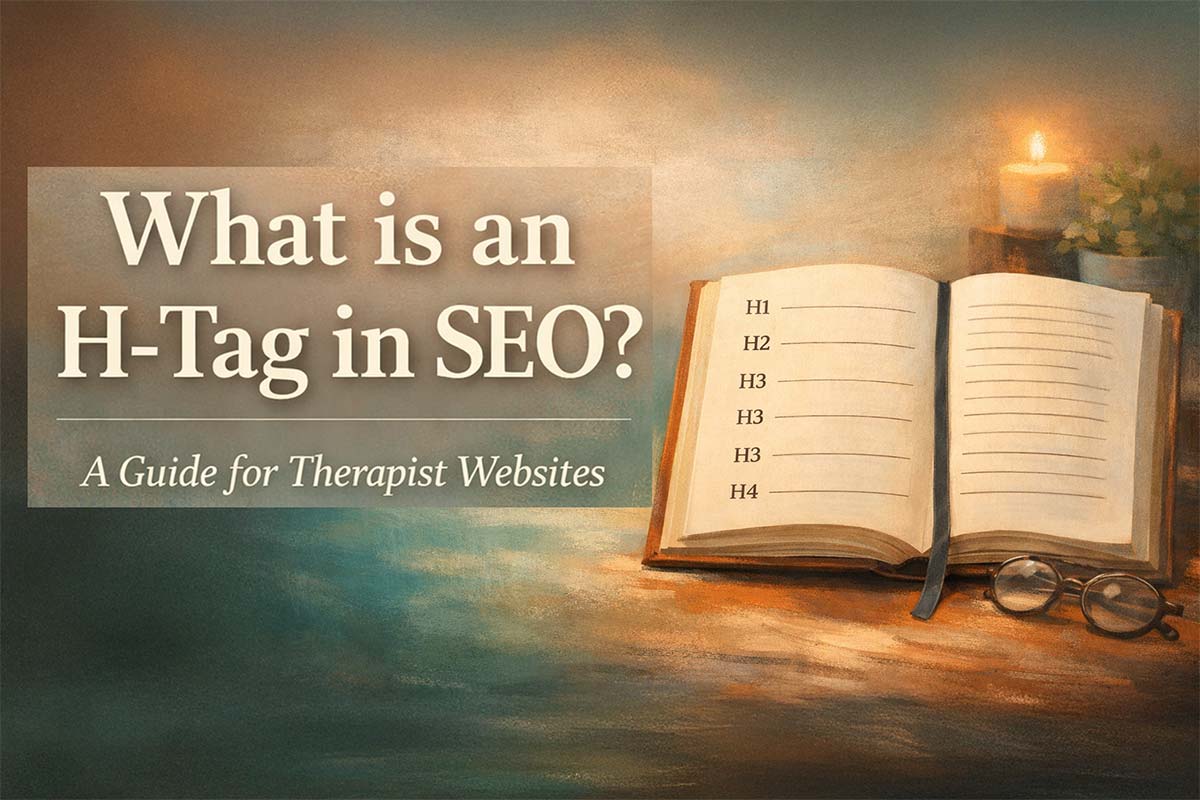
Think of your website like a book. H-tags are the chapters and subchapters that organize your ideas. Without them, your content becomes a wall of text. With them, it becomes structured, readable, and meaningful.
For therapists, this carries more weight than most industries. Your website is not just trying to rank. It is trying to build trust. Clear structure helps potential clients quickly understand what you do, while also signaling to Google and AI tools how your content is organized and what it represents.
Search engines have always relied on structure to crawl and index pages. AI now builds on that. It does not just scan keywords. It interprets meaning. Proper heading structure, combined with clear content, functions similarly to structured data. It helps both Google and AI interpret your expertise accurately.
When H-tags are used correctly, they:
- Organize your content into clear, digestible sections
- Improve how search engines and AI interpret your page
- Create a smoother and more trustworthy experience for potential clients
When they are used poorly or not used at all, your content becomes harder to understand, harder to rank, and less trustworthy.
Optimizing H-tags is not about manipulating SEO. It is about creating clarity for humans first, and now for AI alongside them.
Key Takeaways
- H-tags organize content and signal structure to search engines.
- Proper H-tag usage enhances both SEO and user experience.
- Optimizing H-tags involves strategic placement for better ranking.
Understanding HTML Headings and H-Tags
HTML headings, or H-tags, play a crucial role in organizing content on a webpage. They help structure your text, making it easy for both readers and search engines to understand your content.
The Role of H1 to H6 in SEO
H1 to H6 tags define the headings in your HTML document. The H1 tag is the most important as it usually represents the main title of your page. Subsequent tags (H2 to H6) serve as subheadings.
Each heading tag helps search engines understand the hierarchy and main topics of your content. Proper use of these tags can improve your page’s SEO, helping it rank better in search results.
H-Tag Hierarchy and Content Structure
The hierarchy of H-tags is vital for readability and SEO. An H1 tag should be used for the main title, H2 tags for main section titles, and H3 tags for subsections within each main section.
For example:
-
- H1: Anxiety Therapist in Santa Cruz, CA
- H2: What Anxiety Looks Like
- H3: Racing Thoughts
- H3: Self-Doubt
- H3: Panic Attacks
- H2: How Anxiety is Treated
- H3: Therapy
- H4: EMDR
- H4: IFS
- H4: CBT
- H3: Medication
- H4: SSRI antidepressants
- H4: Benzodiazepines
- H4: Buspirone
- H3: Therapy
- H2: What Anxiety Looks Like
- H1: Anxiety Therapist in Santa Cruz, CA
Maintaining this structure helps both users and search engines navigate your content. Misusing these tags, like skipping from an H2 to an H4, can confuse search engines and worsen your SEO.
How to Best Optimize Your H1 Tag Using Your Primary Keyword
Your H1 tag should include your primary keyword clearly and naturally. This helps search engines understand what your page is about and can improve your ranking.
Make sure your H1 tag is unique and describes the main topic of your page. Avoid keyword stuffing, as this can negatively affect your SEO. Instead, focus on creating a concise, compelling headline that uses your primary keyword effectively.

Optimizing Headings for Search Engine Rankings
Optimizing your headings can significantly impact your search engine rankings. It’s essential to understand how to use keywords, ensure relevance, and avoid keyword stuffing for effective SEO.
Keyword Integration in H-Tags
Including keywords in your headings is crucial for improving search engine rankings. Focus keywords should be placed in H1 tags as this is the primary heading. Use H2 and H3 tags to include related keywords, helping search engines understand your content better.
Be strategic about keyword placement to ensure they appear natural and add value to your SEO efforts. Proper keyword integration can lead to higher traffic and better SERP performance.
Achieving Relevance and Quality with Heading Tags
Relevance and quality are keys to optimizing heading tags. Each heading should accurately reflect the content that follows, keeping it relevant to the user’s search intent. For example, an H2 tag should summarize a main section, while H3 tags break down subsections.
Quality headings improve user experience by making your content easier to navigate. This ensures that both users and search engines can quickly understand the structure and main points of your page, improving overall search engine rankings.
Avoiding Keyword Stuffing in Header Tags
Keyword stuffing in header tags can hurt your SEO efforts. It makes headings look unnatural and reduces content quality. Instead of using too many keywords, focus on creating clear and concise headings that provide real value.
Overloading your headings with unnecessary keywords can lead to a negative user experience and potentially lower your ranking on SERPs. Aim for a balanced approach, incorporating primary keywords without overdoing it. This maintains the integrity of your content while optimizing for search engines.
Enhancing User Experience with Effective Heading Use
Using effective headings can significantly improve readability and accessibility. Clear header tags not only organize content but also make it easier for users to navigate your site.
Navigational Benefits of Headings for Readers
Headings serve as signposts for your readers. They break down long content into manageable sections. By using H1 for the main title and H2 to H6 for subheadings, you create a logical structure.
When your content is well-organized, readers find it easier to locate the information they need. This reduces frustration and keeps them engaged on your page. For instance, when a topic is broken into smaller parts with concise headings, readers can quickly skim through and jump to the section they find most relevant.
Proper use of headings also helps search engines understand the context of your content, potentially improving your SEO ranking. This is especially important for attracting new visitors who might be searching for specific information.
Improving Accessibility with Headings
Headings are crucial for making your website accessible to all users, including those who are visually impaired. Screen readers rely on header tags to navigate web content. When headings are missing or incorrectly used, it creates barriers for visually impaired readers.
Using clear and concise headings helps screen readers to quickly announce sections, making navigation more seamless. This enhances the user experience by ensuring that every reader, regardless of their abilities, can access your content efficiently.
Accessibility isn’t just a best practice; it’s a requirement under various web accessibility guidelines. By prioritizing accessible headings, you ensure compliance and provide a better experience for all your readers.
Technical Implementation of SEO-Friendly H-Tags
Using H-Tags properly can improve the visibility and readability of your content. This section will cover how to utilize WordPress editors and customize tags with CSS and plugins.
Utilizing WordPress Editors for H-Tags
WordPress offers tools for implementing H-Tags efficiently. If you use the Classic Editor, you can highlight your text and select the desired heading level from the “Paragraph” drop-down menu.
In the Block Editor, you can add a Heading block, then choose the heading level (H1, H2, etc.). Make sure your main heading (H1) appears only once per page to maintain a clear structure.
Using WordPress editors helps to organize your content in a logical manner without requiring advanced HTML knowledge.
Customizing Tags with CSS and Plugins
Customizing H-Tags involves CSS and sometimes plugins. You can modify the appearance of H-Tags through your theme’s stylesheet. For example, to change the font size for an H2 tag, you might add:
h2 {
  font-size: 24px;
}
Plugins like Advanced Custom Fields or Header Footer Code Manager can also assist in customizing tags. These tools allow you to add custom code and properties to your H-Tags without directly editing HTML.
Ensuring your H-Tags are visually appealing and different from regular text boosts user engagement and SEO performance.
Frequently Asked Questions
How can H tags improve a therapist’s website SEO?
H tags help Google and other search engines identify the main topics of your content. Using them effectively can improve your site’s visibility by making it easier for search engines to read your pages.
What are the best practices for using H1, H2, and H3 tags in SEO?
Use only one H1 tag per page to define the main topic. H2 tags should be used for subheadings, and H3 tags for further sub-sections. Each tag should include relevant keywords while maintaining a natural flow.
Can the incorrect use of header tags affect a website’s search engine ranking?
Yes. Incorrectly using header tags can confuse search engines and harm your site’s ranking. Overusing H1 tags or misordering H tags can make it harder for search engines to understand your content.
How should H tags be structured for optimal SEO benefits?
Start with a single H1 tag to introduce the primary theme. Use H2 tags for main sections, and H3 tags for sub-sections under those H2 tags. This hierarchical structure aids both search engines and readers.
What is the significance of header tag hierarchy in SEO?
A proper hierarchy ensures that search engines can easily parse through your content. It helps in presenting your content logically, making it easier for search engines to index and improve user readability.
How to optimize H1 tags for better search visibility?
Ensure the H1 tag is descriptive and includes primary keywords relevant to the page’s content. It should clearly convey the main topic and be compelling enough to attract both search engines and readers.