

As a solo practice therapist earning more than $100,000, you could potentially save thousands of dollars in taxes each year.
Want to know the secret to saving money? Elect to have your practice taxed as an S corporation. Here’s the scoop …
- The IRS takes 15.3% of your paycheck to cover Social Security and Medicare taxes¹.
- When you work as a W-2 employee, your employer pays half.
- When you’re self-employed, you pay the whole 15.3%. Lame, I know!
- As an S corp, you can split your income between salary and distributions … and only pay the 15.3% on your salary.
That difference can add up to substantial tax savings. But an S corp also comes with additional costs, payroll requirements, tax filings, and IRS rules, so it isn’t automatically the right choice for every therapist.
To help demystify the world of S corp for therapists, I enlisted the help of David Leichter, my favorite CPA for mental health practices. Everything in this article comes from a live training session we co-hosted recently (you can watch it below).
Keep reading to learn what therapists actually need to understand about S corps, including how they differ from LLCs, when the tax savings may become worthwhile, how to pay yourself, what “reasonable compensation” actually means, and why quarterly tax planning still matters.
What Could an S Corp Actually Save You?
Here’s where things get interesting. The IRS requires S corp owners who work in their business to pay themselves “reasonable compensation.” But as David explained in our interview , “You need to take a reasonable compensation. Of course, they don’t do us the honors of telling us what that reasonable comp is.” — David Leichter, CPA
David went on to explain that his firm generally tells clients that 40% of practice profit can be dedicated toward salary, with the remaining profit potentially avoiding employment taxes.
So, what could that look like in real dollars? For this simplified example, we’re only looking at Social Security and Medicare taxes. You’ll still owe applicable federal and state income taxes. Using David’s 40% salary guideline:
| Annual Practice Profit | Assumed W-2 Salary | Potential Annual Savings* |
|---|---|---|
| $75,000 | $30,000 | ~$6,000 |
| $100,000 | $40,000 | ~$8,000 |
| $125,000 | $50,000 | ~$10,000 |
| $150,000 | $60,000 | ~$12,000 |
| $175,000 | $70,000 | ~$14,000 |
| $200,000 | $80,000 | ~$16,000 |
*Simplified estimates comparing self-employment taxes with Social Security and Medicare taxes on an assumed W-2 salary equal to 40% of practice profit. Actual savings vary based on your specific tax situation, salary, state, business structure, and other factors.
And now you can see why mental health S corps get people’s attention. At $100,000 in practice profit, we’re talking about roughly $8,000 in potential annual savings. At $150,000, it’s around $12,000. And at $200,000, it could approach $16,000.
Of course, those are potential savings before accounting for the additional costs of running an therapy S corp, including payroll, tax preparation, bookkeeping, and other administrative expenses. And 40% isn’t a universal rule. The salary you can reasonably pay yourself depends on your actual circumstances.
Disclaimer: This article is for educational purposes only and is not financial or tax advice. Every practice owner’s financial situation is different, and you should always talk with your CPA or another qualified tax professional before deciding whether an S corp makes sense for you or determining what constitutes reasonable compensation.
When Does an S Corp Actually Make Sense for a Therapist?
After seeing those potential savings, you might be thinking, “Okay, sign me up.” Not so fast.
An S corp for therapists comes with some additional hoops to jump through. You’ll have a separate business tax return to file, you’ll need to run payroll, and you’ll probably want both an accountant and a payroll company helping you manage everything correctly. That means there’s a point where the tax savings are worth the additional expense and hassle … and a point where they probably aren’t.
David explained that if your practice is only making $20,000, $30,000, or $40,000 a year, he’d probably tell you to hold off.
At that stage, the potential savings may not justify all those additional hoops. But once your practice starts making upwards of $100,000, the math can become a lot more interesting.
Remember, these aren’t one-time savings. As your income increases, your savings with the S corporation increases with it. If the S corp continues to make sense for your practice, you potentially benefit from those savings year after year.
Don’t look at $100,000 as some magical number where every therapist should immediately become an S corp. The better question to ask your CPA is: Have I reached the point where my potential annual tax savings outweigh the additional cost and complexity? If the answer is yes, it may be time to seriously consider making the switch.

What is a Distribution?
Before answering the question, there’s an important concept to understand first: as an S corp owner, you wear two hats – employee and shareholder.
Think of it a little like owning stock in your own company. You’re simultaneously an employee doing the work and a shareholder who owns part (or, for many solo practice owners, all) of the business. That means money can come to you in two different ways:
- W-2 salary: Money you receive as an employee for the work you perform for your practice.
- Shareholder distribution: Money you receive as an owner because you own the business and it generated a profit.
Put simply, your salary pays you for working in the business. Your distributions pay you as an owner of the business.
So How Do You Actually Get the Money?
“Wait … if I only pay myself 40%, how do I get the rest of my money?”
Let’s go back to our $100,000 example. If David’s general guideline is to pay yourself 40% as W-2 salary, that means $40,000 goes through payroll. You receive regular paychecks with Social Security, Medicare, and applicable income-tax withholding taken out, just like you would at a traditional W-2 job.
So … what happens to the other $60,000? Do you just stare longingly at it sitting in your business bank account? Fortunately, no. You still have access to that money. You’re just getting it into your personal bank account as an owner rather than as an employee.
The remaining profit can generally be taken as distributions from the business, which David describes as essentially transferring money from your business bank account into your personal account.
Just keep in mind, even though you’re paying Uncle Sam less money on your distributions, you still need to pay the tax man!
Are S Corp Distributions Tax-Free?
This is really important. When we say that the remaining $60,000 can potentially be taken without employment taxes, that does not mean you just discovered $60,000 of magical tax-free money. Don’t we all wish!!!
David emphasized that one of the biggest misconceptions business owners have is thinking they’re taxed based on how much money they actually take out of their business. They’re not. “You are taxed on your business profit. Whatever your profit is, is what you are taxed on.” — David Leichter, CPA
Let’s say your practice makes $100,000 in profit, but you only transfer $10,000 into your personal bank account and leave the other $90,000 sitting in the business. You don’t get to tell the IRS, “Hey, I only took $10,000, so let’s just pretend the other $90,000 doesn’t exist.” As David explained, you’re taxed on the profit, not simply the amount you draw from the business.
Big picture:
S corp distributions can be employment-tax-free. They are not necessarily income-tax-free.
You’re still potentially paying federal and state income taxes on your business profit. The big S corp opportunity we’ve been talking about throughout this article is specifically about reducing the amount of money subject to Social Security and Medicare taxes.
Why Do I Have to Pay Quarterly Taxes As a Therapist S Corp?
When you’re a W-2 employee, taxes are quietly being pulled out of your paycheck throughout the year. Your employer handles the mechanics, and unless something unusual is going on with your taxes, you probably don’t spend much time thinking about it.
If you’re a sole proprietor, you should be already paying quarterly taxes. Nothing changes when you choose an S corporation election.
In our training, David shared a cautionary tale of clinicians who finish their first profitable year, only to discover that their $100,000 of income has created a tax bill they weren’t expecting.
David’s firm does tax projections for clients based on how much they’ve made so far, what they’re projected to make for the rest of the year, and what that is likely to mean for their overall tax bill. From there, they can determine approximately how much should be paid in estimated taxes.
They’re called estimated payments for a reason. You might pay a little too much and get some money back. You might pay a little too little and owe something at tax time.
The goal isn’t necessarily to hit $0.00 perfectly. The goal is to avoid getting to tax season and hearing, “Surprise! You owe $30,000.”
What Are the Additional Costs of Running an S Corp?
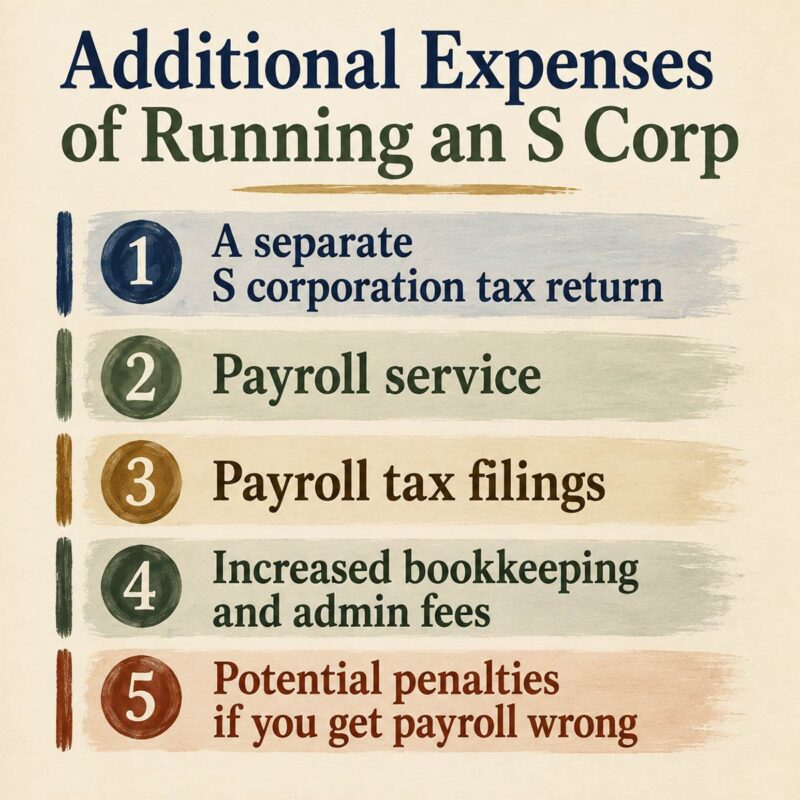
The potential tax savings sound great, but running an S corp also comes with additional expenses and responsibilities. Before making the switch, factor in:
- A separate S corporation tax return — Your business now has its own tax filing requirements in addition to your personal return.
- Higher accounting costs — With the added complexity, you’ll probably want a CPA handling your business and personal tax returns.
- Payroll service — Because you’re paying yourself a W-2 salary, you’ll need to run payroll. David recommends using a payroll provider rather than trying to manage this yourself.
- Payroll tax filings — Your business needs to withhold, report, and remit the appropriate payroll taxes throughout the year.
- Bookkeeping and administration — There’s simply more financial paperwork and recordkeeping involved with an S corp.
- Potential penalties if you get payroll wrong — Payroll reporting builds from quarter to quarter, so mistakes can compound and potentially result in corrections, penalties, or fines.
The real question is whether the tax savings outweigh these additional costs. If an S corp saves you $1,000 but costs you $2,000 to maintain, it probably doesn’t make much sense. If you’re potentially saving $8,000, $12,000, or more each year, the math starts looking very different.
That’s a conversation to have with your CPA.
What’s the Difference Between an LLC and an S Corp?
This is one of the most confusing questions for therapists thinking about changing their business structure. It definitely befuddled me when I changed Goodman Creatives from a sole proprietorship to an LLC taxed as an S corp a few years ago. You’ll hear one practice owner say, “I have an LLC,” another say, “I have a PLLC,” and someone else say, “I’m an S corp.”
It sounds like three different options. They’re not.
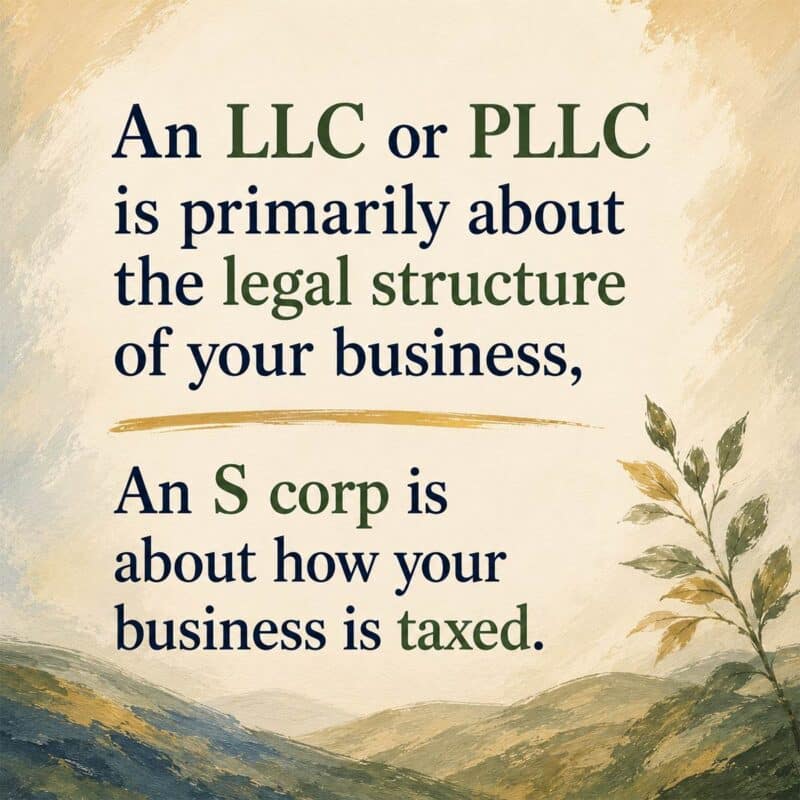
As David explains it, an LLC or PLLC is primarily about the legal structure of your business, while an S corporation is about how your business is taxed.
Here’s the simplest way to think about it:
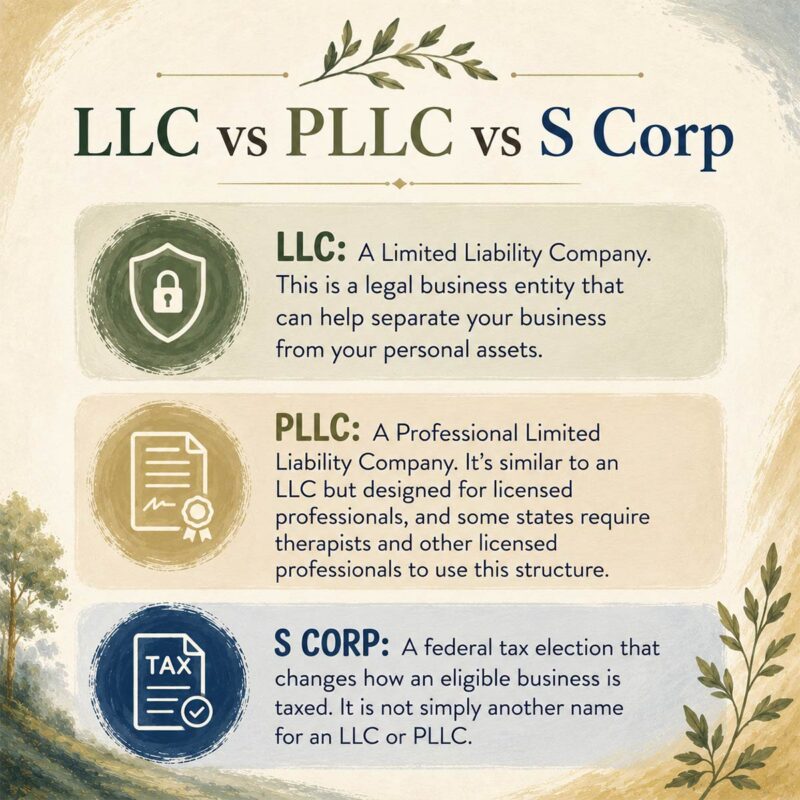
- LLC: A Limited Liability Company. This is a legal business entity that can help separate your business from your personal assets.
- PLLC: A Professional Limited Liability Company. It’s similar to an LLC but designed for licensed professionals, and some states require therapists and other licensed professionals to use this structure.
- S Corp: A federal tax election that changes how an eligible business is taxed. It is not simply another name for an LLC or PLLC.
How an LLC or PLLC Becomes an S Corp
That last point is where things tend to get confusing.
Simply creating a single-member LLC (or PLLC) doesn’t automatically give you the S corp tax savings we’ve been talking about. For federal tax purposes, a default single-member LLC can generally still be taxed like a sole proprietorship, meaning the business profit flows through to your personal tax return and is generally subject to self-employment tax.
The S corp election changes that. In the process David describes, the therapist establishes the appropriate business entity and then files Form 2553 with the IRS to elect S corporation tax treatment. That’s what opens the door to paying yourself a reasonable W-2 salary while taking additional profits as distributions.
So instead of thinking LLC vs. PLLC vs. S corp, think:
- LLC or PLLC = what your business is.
- S corp = how your business elects to be taxed.
There are important state-specific exceptions here, especially for licensed professionals. Whether you can form an LLC, need a PLLC or another professional entity, and whether an S corp election makes sense for you depends on where you practice and your individual circumstances.
So yes, talk to your CPA and, when appropriate, an attorney before making the switch.
FAQs About S Corporations For Therapists
Do I have to file an extra tax return as an S corp?
Yes. Once you elect S corporation taxation, your business generally files its own tax return, Form 1120-S, typically due March 15 for calendar-year businesses. You’ll still file your personal tax return separately, generally in April.
That doesn’t necessarily mean paying another round of federal income taxes in March. S corporations generally pass their income through to their owners, who report their share on their personal returns. What it does mean is another tax return for your CPA to prepare—and another accounting bill to factor into the cost of maintaining your S corp.
Do I need a separate business bank account for a mental health S corp?
You should keep your business and personal finances separate. Your practice income and expenses should run through your business account, your W-2 salary should be processed through payroll, and distributions can then be transferred from the business to your personal account.
Beyond keeping things organized, clean separation makes it much easier for your bookkeeper and CPA to understand exactly what happened with your money throughout the year.
Can I change my W-2 salary if my therapy practice grows?
Yes. The salary you establish when you first become an S corp doesn’t necessarily remain your salary forever. If your practice income grows significantly or your responsibilities change, the amount considered “reasonable compensation” may change too.
That’s another reason to revisit your salary with your CPA periodically rather than deciding on a number once and assuming you’re good forever.
What happens if I hire therapists and turn my solo practice into a group practice?
This is where things can get more interesting. As you hire therapists, your group practice may generate substantially more revenue and profit. But your own job may also begin changing from primarily providing therapy to running the business. Plus, you’ll probably need to invest in therapist web design and marketing services.
That can affect the financial picture we’ve been discussing, including how much profit is available for distributions and what constitutes reasonable compensation for the work you actually perform. Growing into a group practice is a good reason to have your CPA rerun the numbers rather than continuing to use the salary and tax strategy that made sense when you were solo.
Can I switch back if an S corp stops making sense?
Yes, an S corporation election can generally be revoked, but there are IRS rules governing how and when you do it—and restrictions can apply if you later decide you want to elect S corp taxation again.
So if your income drops, your practice changes, or the additional costs simply stop being worth the savings, talk to your CPA before making a change. You aren’t necessarily married to your S corp forever, but you also don’t want to turn the election on and off casually.
What if an S Corp doesn’t make sense for my practice yet?
Maybe you got this far and realized you’re not there yet.
That’s okay.
If your practice is still growing and you’re making $30,000 or $40,000 in profit, David’s advice isn’t that you’ve failed some secret therapist-business-owner test. He specifically says that at those income levels, the additional hoops involved with an S corp may not make sense yet.
That doesn’t mean there’s nothing you can do to reduce your tax burden.
David mentioned retirement accounts, home-office deductions, and other business deductions as additional strategies therapists may be able to use. In fact, David has put together a Tax Deduction Checklist for Therapists specifically for this purpose. It includes potential deductions applicable to mental health professionals and is available for free on his website.
-> Download David’s Tax Deduction Checklist here
And perhaps the bigger lesson from our entire conversation is that tax planning shouldn’t be something you think about for three panicked days in April. As your practice grows, the financial decisions you make start to matter more. Maybe an S corp doesn’t save you enough money to justify the hassle today. Maybe next year it does.
The important thing is knowing that these options exist … and having a CPA who understands private practice well enough to help you figure out when it’s time to use them.
Because as David put it:
“A dollar saved is a dollar earned, and that’s your money.”
About David Leichter, CPA
David Leichter is the founder and CEO of Leichter Accounting Services, having built the firm from scratch about 15 years ago into a team of accountants whose passion is to help mental health practitioners navigate the complexities of business accounting and taxes.
The company’s core values are exceptional service and high-quality work. They understand therapists’ challenges with finances and taxes and do everything they can to help you better understand what you need to do and how you can save.
Connect with David
 Greg Goodman: