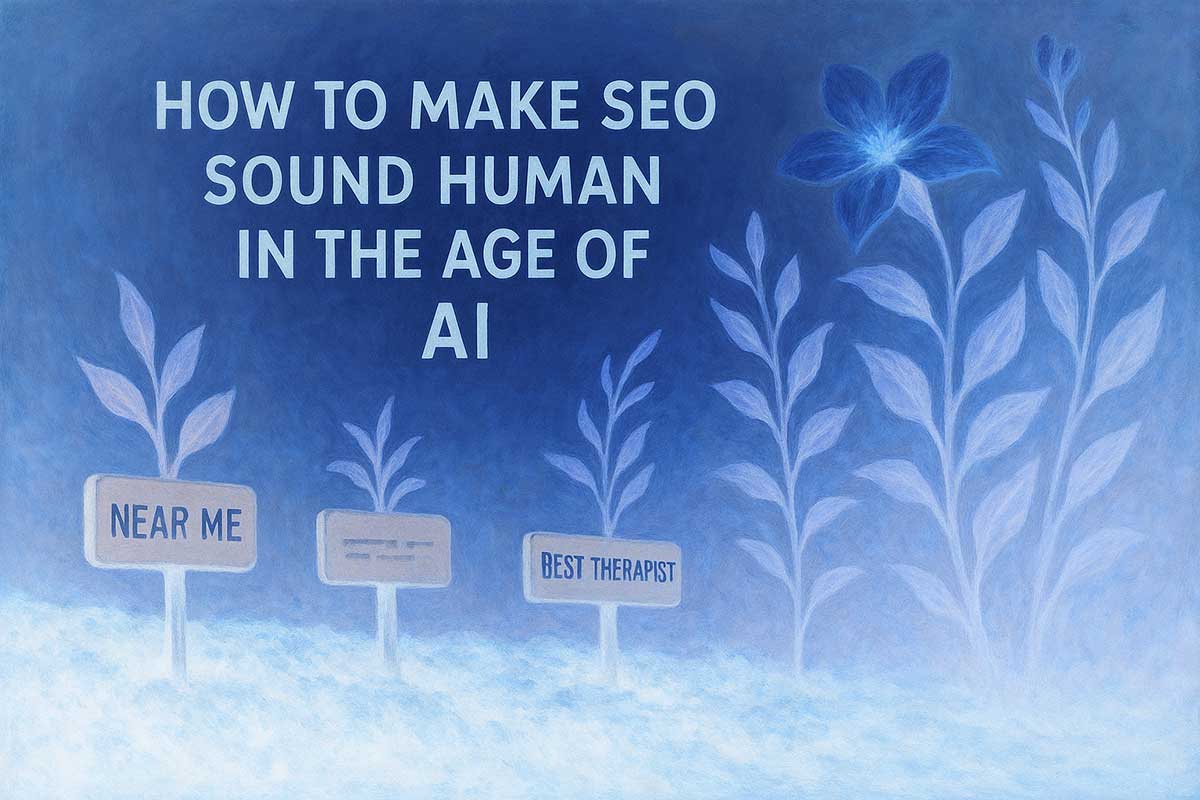
Ever visit a therapist’s website and think, “Wow, this sounds like a robot wrote it?”
For years, ranking on Google meant stuffing your website with the most awkward, unnatural keywords you could think of. Things like “best anxiety counseling NYC,” “therapist Santa Cruz,” “OCD specialist near me,” and other clunky phrases were repeated over and over because that’s what the algorithms seemed to reward.
And for a long time, that strategy actually worked. But the world of search engine optimization is changing — quickly.
As AI becomes more integrated into search engines and Google gets better at understanding context, intent, and natural language, you no longer need to force those stiff, robotic phrases into every corner of your website.
Yes, keywords are still important. They still help Google understand what your page is about. But the old style of repeating awkward exact-match phrases everywhere is no longer the most effective (or professional) way to write website copy.
Today, search engines are much better at recognizing the meaning behind a phrase. They understand that “CBT therapist on Long Island” is the same idea as “CBT therapist Long Island,” even if the wording is different.
In this post, we’ll walk through what this change means for your private practice, why natural language now matters more than ever, and how to balance solid SEO with copy that feels warm, grounded, and authentically you.
The Evolution of SEO Keywords on Therapist Websites
Before we look at how SEO has changed, it may help to understand the perspective behind this guidance. I have been building therapist websites and helping private practices with SEO since 2006. Over that time, I have watched major shifts in how Google evaluates content, understands user intent, and now moves toward GEO for therapists … Google’s evolving format for generative and context-aware search results.
The information in this article comes from firsthand testing, ongoing analysis, and direct observation of how these changes are affecting real therapy websites today. It reflects current best practices and the adjustments we are making to keep our clients aligned with the newest search expectations.
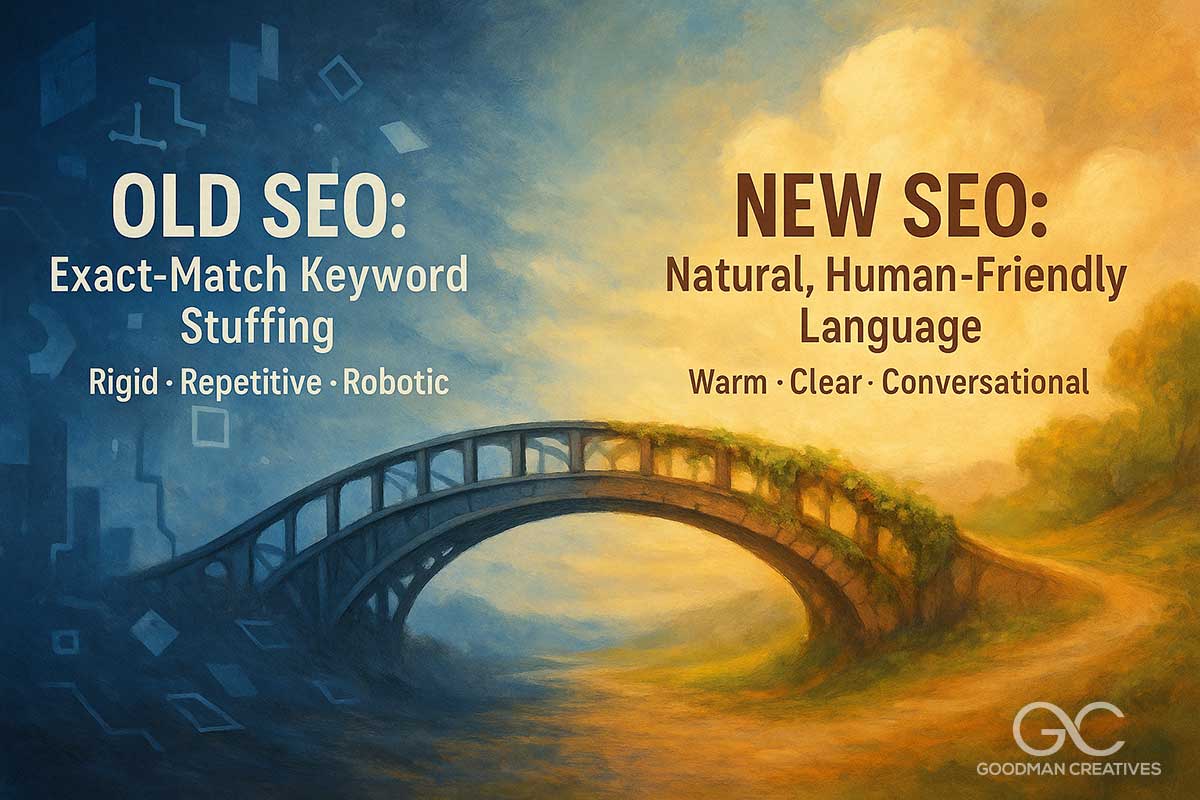
THE OLD WAY … Exact Keyword Matching Made Websites Sound Robotic
In the early years of SEO for therapists, search engines depended heavily on exact keyword matching. If someone typed “best anxiety counseling NYC,” the algorithms scanned websites looking for that precise phrase. Primary SEO keywords and exact-match keyword frequency was treated as a major relevance signal. Academic analyses of early search architectures describe this period as dominated by strict lexical matching, where engines relied on literal text similarity rather than meaning or context.
For therapists, this created a problem. In an effort to rank higher, websites were stuffed with phrases like “OCD specialist near me” or “CBT therapy Long Island.”
These strings were repeated in headings, paragraphs, sidebars, and footers. The strategy could boost visibility, but it also made the writing feel unnatural, robotic, and disconnected from how therapists actually speak. As a result, potential clients were often greeted with website copy that felt cold or mechanical… the opposite of what creates trust and safety.
This “old way” of SEO forced therapists to choose between rankingon Google or sounding human. Fortunately, that choice is no longer necessary.
THE NEW WAY … Semantic Search, NLP, and Machine Learning Are the Keys to Human-Sounding SEO
Search engines have moved far beyond literal string matching. Developments in natural language processing, semantic search, and machine learning now allow Google to interpret meaning, intent, and relationships between concepts.
Semantic search systems evaluate context instead of relying exclusively on exact word order. Industry research describes this as a shift from keyword matching to understanding the conceptual meaning behind queries. (source)
Peer-reviewed studies comparing semantic retrieval methods with keyword-based systems consistently show that semantic approaches provide more accurate results for conversational and natural queries. These systems use techniques like word embeddings, vector space models, and contextual analysis to match a user’s intent rather than their exact phrasing. (source)
For therapists, this shift is liberating. Google can now understand that “CBT therapist on Long Island” carries the same meaning as the old, awkward “CBT therapist Long Island.”
You no longer need to force the stiff version into your main headlines or emotionally sensitive sections. Natural language reads better, feels more professional, and creates a stronger emotional connection… and modern search engines are fully capable of interpreting it correctly.
This means your website can finally do both. It can follow SEO best practices and still reflect your authentic therapeutic voice. In the next section, we will look at how to put this into practice.
Why Natural Language Is Better for Therapists
Your Clients Need Calm, Not Clunky Copy
Someone searching for a therapist is often anxious, overwhelmed, or unsure where to begin. When they land on a page filled with stiff or robotic phrases (even if those phrases technically help with SEO) it can create an immediate sense of disconnection.
Awkward language does not feel safe. It does not feel human. And safety is the foundation of a therapeutic relationship. Natural language helps visitors feel grounded the moment they arrive.
Natural Language Builds Trust
Warm, human-sounding copy mirrors the tone of a real therapeutic conversation. Research in psychotherapy and communication shows that warmth, empathy, and congruence shape whether someone feels connected to a clinician. These same principles apply online. When your website sounds like you, your potential clients feel more at ease and trust is built.
Because semantic search rewards meaningful, high-quality content, you are free to write in a voice that reflects your personality, values, and therapeutic style. Your site can finally represent who you are … not who an outdated SEO formula told you to be.
Better Reader Experience Helps Your SEO
There is an SEO benefit as well. When people stay on your site longer because the writing feels clear and comfortable, search engines interpret that engagement as a sign that your content is helpful. Industry analyses note that user satisfaction metrics such as time on page and reduced bounce rate support stronger SEO results. Natural language encourages visitors to stay and explore … and that helps Google see your site as valuable. (source)
Wait… Do Keywords Still Matter? (Yes, But Not How You Think)
Even though search engines are getting much better at understanding natural, human language, keywords have not disappeared. They still play an important role in helping Google understand what your page is about.
The difference is that you no longer need to put stiff or awkward phrases in your main headlines or the most emotional parts of your site. Instead, you can place those exact-match terms in quieter areas … the parts of your page that readers do not focus on, but search engines still scan.
This balanced approach matters because research on semantic search shows that Google now looks at both meaning and keywords when deciding what a page is about.
Studies comparing keyword-based systems with semantic search also show that meaning-focused models do a better job understanding natural, conversational queries … which is exactly how most people search for a therapist. In other words, natural phrasing leads … and well-placed keywords support it behind the scenes. (source)
This shift gives therapists the best of both worlds. You can write in a warm, grounded voice that feels authentic to you, while still giving Google the information it needs to help the right clients find you.
Yes … You Need to Include “Near Me” Keywords
Many people find therapists using searches like “therapist near me,” “anxiety counseling NYC,” or “CBT therapist [your city].” That local and immediate-intent search behavior remains extremely strong, which means optimizing for “near me” and local keywords isn’t optional if you want to reach people ready to act.
- About 46% of all Google searches have local intent — nearly half of all traffic is potentially someone looking for a nearby therapist. (source)
- For mobile searches with local intent, many users contact or visit a business within 24 hours — meaning “near me” searches often lead to immediate action. (source)
These numbers show that local-search traffic is huge and it’s full of people searching locally who are often ready to reach out, book a session, or take a next step. But, you do not need to put “near me” in your most visible copy. You only need to use the exact phrase once on the page to give Google the signal it needs. After that, you can switch to smoother, semantic variations like “in your area” or “local therapist who treats OCD.”
Exact Match vs. Semantic Match Examples
Modern search engines can understand meaning, not just exact word order. That means you should still use the exact-match phrase at least once on your page … but instead of sprinkling it awkwardly a dozen times, you can mix in natural-language (semantic) variations that feel smoother and more human.
Here are five examples to show how this works in practice. Each set includes the original exact-match keyword along with three semantic versions that communicate the same idea in a more readable way.
Exact Match:
- CBT therapy Long Island
Semantic Matches:
- CBT therapy on Long Island
- Cognitive behavioral therapy on Long Island
- CBT-based support for people on Long Island
Exact Match:
- Anxiety counseling NYC
Semantic Matches:
- Anxiety counseling in NYC
- Support for anxiety through counseling in New York City
- Counseling for anxiety symptoms in NYC
Exact Match:
- OCD specialist near me
Semantic Matches:
- OCD specialist in your area
- Local therapist who treats OCD
- OCD-focused therapy available close to you
Exact Match:
- Trauma therapist Austin
Semantic Matches:
- Trauma therapy in Austin
- A therapist in Austin who supports trauma healing
- Trauma-informed counseling available in the Austin area
Exact Match:
- EMDR therapy Los Angeles
Semantic Matches:
- EMDR therapy in Los Angeles
- Eye Movement Desensitization and Reprocessing therapy offered in LA
- EMDR support for trauma recovery in the Los Angeles area
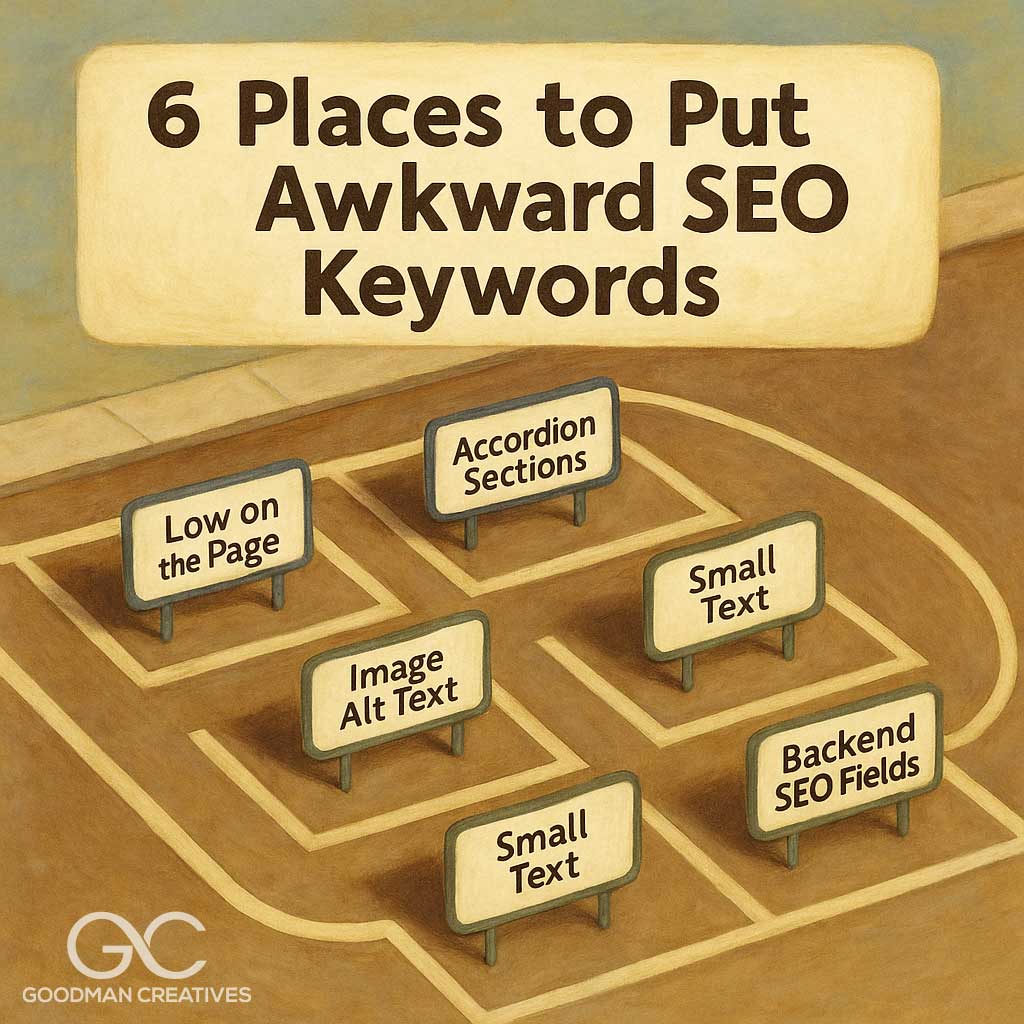
Where to Put the Awkward SEO Keywords
Even though natural language should guide your most visible content, awkward or exact-match SEO phrases still have value. They help search engines understand what your page is about … but they should never overshadow clarity, warmth, or professionalism.
Here are the six best places to use those stiff keywords without disrupting your message.
Low on the Page
Once a visitor feels grounded and engaged, they are less likely to be startled by a slightly awkward phrase. Mid-page or bottom-of-page placement works well for exact-match terms, including:
- Smaller subheads
- Supporting paragraphs
- Service descriptions further down the page
Inside Accordion Sections
Accordion FAQs are ideal for exact-match keywords because:
- They are not immediately visible
- Readers expect them to be a little more technical
- Search engines scan the accordion headers
In Meta Descriptions
Meta descriptions help search engines interpret your page, and readers rarely pay close attention to them. They are perfect for awkward phrases such as:
- “CBT therapist Long Island”
- “Anxiety counseling NYC”
- “OCD specialist near me”
Inside Image Alt Text
Alt text gives search engines and screen readers context about your images. It is a strong place for exact-match terms, such as:
- “CBT therapist Long Island office interior”
- “Anxiety therapist NYC counseling room”
- “OCD specialist near me treatment space”
Backend SEO Fields
Your CMS or SEO plugins often include behind-the-scenes fields where exact-match phrases work well, including:
- Focus keyword fields
- Internal SEO descriptions
- Image file names
- SEO plugin suggestions
- Schema
Never in Your Most Visible Copy
Avoid rigid SEO strings in any high-impact areas that shape first impressions, such as:
- H1 headlines
- Hero sections
- First paragraphs
- Large typography
- Emotionally sensitive or trust-building copy
A Simple 4-Step Natural-Language SEO Writing Process
Now that you know why natural language matters and where the awkward phrases should go, the next step is understanding how to write your pages in a way that feels human and still supports SEO. This four-step process keeps things clear, simple, and therapist-friendly.
1. Start With Human-First Copy
Begin by writing exactly as you would speak to a potential client. Imagine someone sitting across from you feeling overwhelmed, confused, or unsure where to start. Write to that person. Do not think about search engines during this part. Human-first writing comes before all SEO strategy.
2. Shape the Emotional Journey
Once your draft is written, read through it with one question in mind:
What do I want the reader to feel here?
Make sure the copy maintains a tone that is:
- calm
- supportive
- grounding
- consistent throughout
Therapists do this naturally in session. Your website should feel the same way.
3. Add SEO Gently
Now that your copy sounds human, start adding your SEO phrases where they naturally fit. If a phrase sounds even a little robotic or forced … do not put it in your main copy. Focus on:
- natural keyword variations
- a few mid-page subheads
- a sentence or two that describes what you offer and where
- strategically placing awkward exact-match terms in the quieter areas you learned about earlier
4. Refine for Warmth, Clarity, and Trust
Read your page out loud. Anything that feels stiff, dramatic, or unnatural needs to be softened or rewritten. Your goal is to end up with copy that feels like a conversation with a calm, compassionate professional … not a sales pitch or a list of keywords. Check for:
- emotional tone
- sentence flow
- consistent capitalization
- readability
- a grounded, supportive voice
Parting Thoughts
SEO used to feel complicated, rigid, and a little robotic. But the shift toward semantic search and human-centered writing means your website can finally sound warm, clear, and true to who you are as a therapist.
By using natural language in your most important sections, adding exact-match keywords only where they make sense, and mixing in semantic variations throughout the page, you are giving both Google and your potential clients exactly what they need.
The goal is simple. Write in a way that feels supportive and human … then let SEO enhance it rather than control it.
When you do that, your website becomes something much more meaningful … a place where people feel grounded, understood, and ready to take the next step toward healing.
And if you want support bringing all of this together, you do not have to figure it out alone. Our team of copywriters, therapist website designers, and SEO experts specializes in creating therapy websites that look beautiful, feel authentic, and rank well … without ever sounding robotic or salesy.
Whenever you are ready, we are here to help you build a website that reflects your therapeutic voice and connects with the clients you are meant to serve. Reach out today to learn more.
 Greg Goodman: